
Ch. 9 - First-Order Differential Equations
Hass - Thomas' Calculus 15th Edition
Hass15th EditionThomas' CalculusISBN: 9780137616077Not the one you use?Change textbook
Chapter 9, Problem 9.1.25

Show that the solution of the initial value problem
y' = x + y, y(x₀) = y₀
is
y = -1 -x + (1 + x₀ + y₀) exp(x-x₀).

Verified step by step guidance
1
Recognize that the given differential equation is a first-order linear ordinary differential equation of the form \(y' - y = x\).
Identify the integrating factor \(\mu(x)\), which is given by \(\mu(x) = e^{\int -1 \, dx} = e^{-x}\).
Multiply both sides of the differential equation by the integrating factor to get \(e^{-x} y' - e^{-x} y = x e^{-x}\), which simplifies to \(\frac{d}{dx}(e^{-x} y) = x e^{-x}\).
Integrate both sides with respect to \(x\): \(\int \frac{d}{dx}(e^{-x} y) \, dx = \int x e^{-x} \, dx\), leading to \(e^{-x} y = \int x e^{-x} \, dx + C\).
Solve the integral on the right side using integration by parts, then multiply both sides by \(e^{x}\) to isolate \(y\). Finally, apply the initial condition \(y(x_0) = y_0\) to solve for the constant \(C\) and write the solution in the form \(y = -1 - x + (1 + x_0 + y_0) e^{x - x_0}\).

Verified video answer for a similar problem:

This video solution was recommended by our tutors as helpful for the problem above.
Video duration:
3m
Was this helpful?

Key Concepts

Here are the essential concepts you must grasp in order to answer the question correctly.

First-Order Linear Differential Equations

A first-order linear differential equation has the form y' + p(x)y = q(x). Such equations can be solved using an integrating factor, which simplifies the equation into an exact derivative, allowing integration to find the general solution.
Recommended video:
07:39
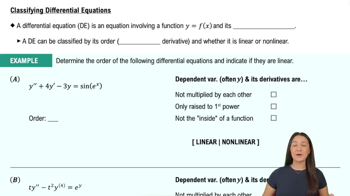
Classifying Differential Equations

Integrating Factor Method

The integrating factor is a function, usually denoted μ(x) = exp(∫p(x) dx), used to multiply both sides of a linear differential equation. This transforms the left side into the derivative of (μ(x)y), enabling straightforward integration to solve for y.
Recommended video:
07:33
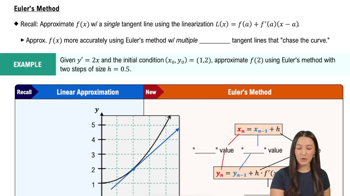
Euler's Method

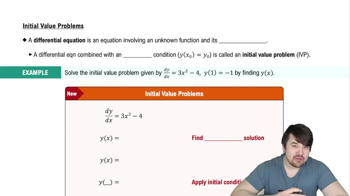
Initial Value Problem (IVP)

An initial value problem specifies the value of the solution at a particular point, y(x₀) = y₀. After finding the general solution, the initial condition is used to determine the constant of integration, yielding the unique solution that satisfies the problem.
Recommended video:
05:03
Initial Value Problems