Use Euler’s method with dx = 0.2 to estimate y(2) if y′ = y/x and y(1) = 2. What is the exact value of y(2)?
Ch. 9 - First-Order Differential Equations
Chapter 9, Problem 9.2.30
Solve the Bernoulli equations in Exercises 29–32.
y' - y = xy²
Verified step by step guidance1
Identify the given differential equation as a Bernoulli equation. The general form of a Bernoulli equation is \(y' + P(x)y = Q(x)y^n\). Here, rewrite the equation \(y' - y = xy^2\) as \(y' + (-1) y = x y^2\), so \(P(x) = -1\), \(Q(x) = x\), and \(n = 2\).
Make the substitution \(v = y^{1-n} = y^{1-2} = y^{-1}\). This substitution transforms the nonlinear equation into a linear one in terms of \(v\).
Differentiate \(v = y^{-1}\) with respect to \(x\) to find \(v'\). Using the chain rule, \(v' = -y^{-2} y' = -\frac{y'}{y^2}\).
Rewrite the original equation in terms of \(v\) and \(v'\). From the original equation, express \(y'\) as \(y' = y + x y^2\). Substitute \(y' = -y^2 v'\) and \(y = \frac{1}{v}\) to get an equation involving \(v\) and \(v'\).
Simplify the resulting equation to obtain a linear first-order differential equation in \(v\): \(v' + P(x)(1-n) v = (1-n) Q(x)\). Then solve this linear equation using an integrating factor.

Verified video answer for a similar problem:
This video solution was recommended by our tutors as helpful for the problem above.
Video duration:
8mWas this helpful?
Key Concepts
Here are the essential concepts you must grasp in order to answer the question correctly.
Bernoulli Differential Equation
A Bernoulli differential equation has the form y' + P(x)y = Q(x)y^n, where n is any real number other than 0 or 1. It is nonlinear due to the y^n term but can be transformed into a linear equation using an appropriate substitution.
Recommended video:
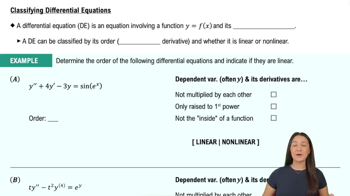
Classifying Differential Equations
Substitution Method for Bernoulli Equations
To solve a Bernoulli equation, use the substitution v = y^(1-n), which converts the nonlinear equation into a linear differential equation in terms of v. This allows the use of standard methods for linear equations to find the solution.
Recommended video:
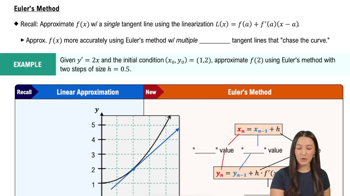
Euler's Method
Solving Linear First-Order Differential Equations
Once transformed, the equation becomes linear and can be solved using an integrating factor, μ(x) = e^(∫P(x)dx). Multiplying through by μ(x) simplifies the equation, enabling integration and solution for the dependent variable.
Recommended video:
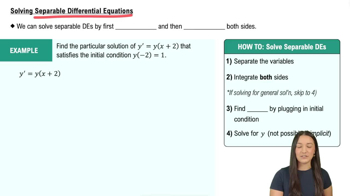
Solving Separable Differential Equations
Related Practice
Textbook Question
Textbook Question
First-Order Linear Equations
Solve the differential equations in Exercises 1–14.
xdy/dx + y = e ͯ, x > 0
Textbook Question
Solving Initial Value Problems
Solve the initial value problems in Exercises 15–20.
dy/dt + 2y = 3, y(0) = 1
Textbook Question
What integral equation is equivalent to the initial value problem y' = f(x), y(x₀) = y₀?
Textbook Question
Using Euler’s Method
In Exercises 15–20, use Euler’s method to calculate the first three approximations to the given initial value problem for the specified increment size. Calculate the exact solution and investigate the accuracy of your approximations. Round your results to four decimal places.
y' = 2y/x, y(1) = -1, dx = 0.5
1
views
Textbook Question
Solving Initial Value Problems
Solve the initial value problems in Exercises 15–20.
dy/dx + xy = x, y(0) = -6