Ch. 9 - First-Order Differential Equations
Hass - Thomas' Calculus 15th Edition
Hass15th EditionThomas' CalculusISBN: 9780137616077Not the one you use?Change textbook
Chapter 9, Problem 9.PE.9

In Exercises 1–22, solve the differential equation.
2y' - y = xe^(x/2)

Verified step by step guidance
1
Rewrite the given differential equation in standard linear form. Start with the equation: \(2y' - y = xe^{x/2}\). Divide both sides by 2 to isolate \(y'\): \(y' - \frac{1}{2}y = \frac{x}{2} e^{x/2}\).
Identify the integrating factor (IF) for the linear differential equation \(y' + P(x)y = Q(x)\), where \(P(x) = -\frac{1}{2}\). The integrating factor is given by \(\mu(x) = e^{\int P(x) \, dx}\). Calculate \(\mu(x) = e^{\int -\frac{1}{2} \, dx} = e^{-x/2}\).
Multiply both sides of the differential equation by the integrating factor \(e^{-x/2}\) to make the left side an exact derivative: \(e^{-x/2} y' - \frac{1}{2} e^{-x/2} y = \frac{x}{2} e^{x/2} e^{-x/2}\). Simplify the right side to \(\frac{x}{2}\).
Recognize that the left side is the derivative of the product \(y e^{-x/2}\), so write \(\frac{d}{dx} \left( y e^{-x/2} \right) = \frac{x}{2}\). Integrate both sides with respect to \(x\): \(\int \frac{d}{dx} \left( y e^{-x/2} \right) dx = \int \frac{x}{2} \, dx\).
After integration, solve for \(y\) by multiplying both sides by \(e^{x/2}\). This will give the general solution to the differential equation in terms of \(x\) and the constant of integration.

Verified video answer for a similar problem:

This video solution was recommended by our tutors as helpful for the problem above.
Video duration:
6m
Was this helpful?

Key Concepts

Here are the essential concepts you must grasp in order to answer the question correctly.

First-Order Linear Differential Equations

A first-order linear differential equation has the form y' + P(x)y = Q(x). It can be solved using an integrating factor, which simplifies the equation into an exact derivative, allowing integration to find the solution.
Recommended video:
07:39
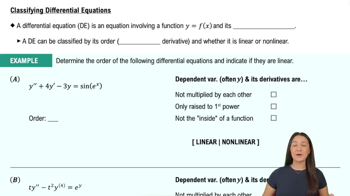
Classifying Differential Equations

Integrating Factor Method

The integrating factor is a function, usually denoted μ(x), defined as e^(∫P(x)dx). Multiplying the entire differential equation by μ(x) transforms it into a form where the left side is the derivative of μ(x)y, enabling straightforward integration.
Recommended video:
07:33
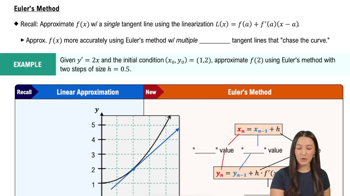
Euler's Method

Solving Nonhomogeneous Differential Equations

Nonhomogeneous differential equations include a nonzero term Q(x). The general solution combines the complementary solution of the associated homogeneous equation and a particular solution found using methods like undetermined coefficients or variation of parameters.
Recommended video:
06:06
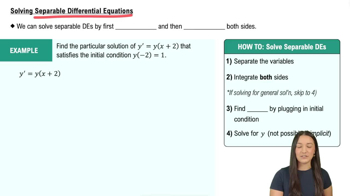
Solving Separable Differential Equations