Ch. 9 - First-Order Differential Equations
Hass - Thomas' Calculus 15th Edition
Hass15th EditionThomas' CalculusISBN: 9780137616077Not the one you use?Change textbook
Chapter 9, Problem 9.PE.28

In Exercises 23–28, solve the initial value problem.
y dx + (3x - xy + 2)dy = 0, y(2) = -1, y < 0

Verified step by step guidance
1
Rewrite the given differential equation in the form \(M(x,y)\,dx + N(x,y)\,dy = 0\), where \(M(x,y) = y\) and \(N(x,y) = 3x - xy + 2\).
Check if the differential equation is exact by verifying if \(\frac{\partial M}{\partial y} = \frac{\partial N}{\partial x}\). Compute \(\frac{\partial M}{\partial y}\) and \(\frac{\partial N}{\partial x}\).
If the equation is not exact, find an integrating factor that depends on either \(x\) or \(y\) to make it exact. Determine which variable the integrating factor depends on by examining the expressions for \(\frac{\partial M}{\partial y}\) and \(\frac{\partial N}{\partial x}\).
Multiply the entire differential equation by the integrating factor to obtain an exact equation. Then, find the potential function \(\Psi(x,y)\) such that \(\frac{\partial \Psi}{\partial x} = M\) and \(\frac{\partial \Psi}{\partial y} = N\).
Use the initial condition \(y(2) = -1\) to solve for the constant of integration after finding the implicit solution \(\Psi(x,y) = C\). Finally, express the solution implicitly or explicitly, considering the condition \(y < 0\).

Verified video answer for a similar problem:

This video solution was recommended by our tutors as helpful for the problem above.
Video duration:
7m
Was this helpful?

Key Concepts

Here are the essential concepts you must grasp in order to answer the question correctly.

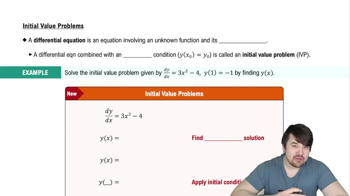
Initial Value Problem (IVP)

An initial value problem involves solving a differential equation with a given initial condition, which specifies the value of the unknown function at a particular point. This condition helps determine a unique solution among many possible ones.
Recommended video:
05:03
Initial Value Problems

Exact Differential Equations

An exact differential equation can be written in the form M(x,y)dx + N(x,y)dy = 0, where there exists a function F(x,y) such that dF = M dx + N dy. Checking if ∂M/∂y = ∂N/∂x helps determine if the equation is exact, allowing integration to find the solution.
Recommended video:
07:39
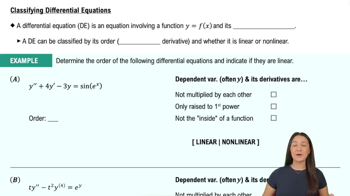
Classifying Differential Equations

Implicit Solution and Solving for y

Often, solutions to differential equations are given implicitly as F(x,y) = C. Using the initial condition, the constant C is found. If possible, the implicit solution can be solved explicitly for y, especially considering domain restrictions like y < 0.
Recommended video:
05:14
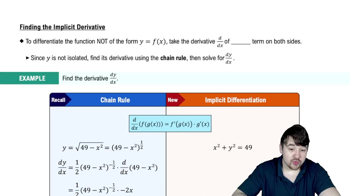
Finding The Implicit Derivative