
Textbook Question
In Exercises 1–22, solve the differential equation.
dy + x(2y - e^(x-x²))dx = 0

 Verified step by step guidance
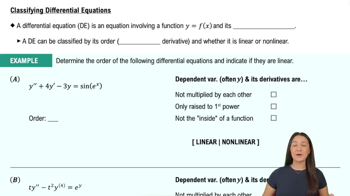
 07:39
07:39
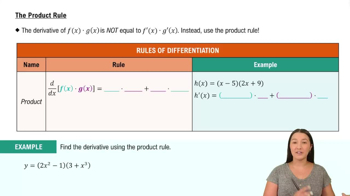 05:18
05:18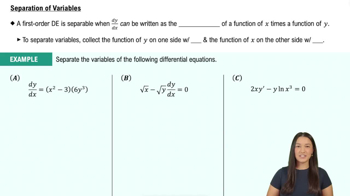 07:15
07:15In Exercises 1–22, solve the differential equation.
dy + x(2y - e^(x-x²))dx = 0
In Exercises 43 and 44, let S represent the pounds of salt in a tank at time t minutes. Set up a differential equation representing the given information and the rate at which S changes. Then solve for S and answer the particular questions.
Pure water flows into a tank at the rate of 4 gal/min, and the well-stirred mixture flows out of the tank at the rate of 5 gal/min. The tank initially holds 200 gal of solution containing 50 pounds of salt.
b. How many pounds of salt are in the tank after 1 minute? after 30 minutes?
In Exercises 43 and 44, let S represent the pounds of salt in a tank at time t minutes. Set up a differential equation representing the given information and the rate at which S changes. Then solve for S and answer the particular questions.
Pure water flows into a tank at the rate of 4 gal/min, and the well-stirred mixture flows out of the tank at the rate of 5 gal/min. The tank initially holds 200 gal of solution containing 50 pounds of salt.
c. When will the tank have exactly 5 pounds of salt and how many gallons of solution will be in the tank?
In Exercises 1–22, solve the differential equation.
y' = sin³ x cos² y
In Exercises 1–22, solve the differential equation.
2y' - y = xe^(x/2)
In Exercises 1–22, solve the differential equation.
y' = (y²-1)x⁻¹