Ch. 8 - Techniques of Integration
Hass - Thomas' Calculus 15th Edition
Hass15th EditionThomas' CalculusISBN: 9780137616077Not the one you use?Change textbook
Chapter 8, Problem 8.1.30

The integrals in Exercises 1–44 are in no particular order. Evaluate each integral using any algebraic method, trigonometric identity, or substitution you think is appropriate.
∫ 3 sinh(x/2 + ln 5) dx

Verified step by step guidance
1
Recognize that the integral involves the hyperbolic sine function \( \sinh \left( \frac{x}{2} + \ln 5 \right) \). Recall that \( \sinh(u) = \frac{e^{u} - e^{-u}}{2} \), which can be useful for integration.
Let \( u = \frac{x}{2} + \ln 5 \). Then, compute \( du = \frac{1}{2} dx \), which implies \( dx = 2 du \). This substitution will simplify the integral.
Rewrite the integral in terms of \( u \): \( \int 3 \sinh(u) dx = \int 3 \sinh(u) \cdot 2 du = \int 6 \sinh(u) du \).
Integrate \( \sinh(u) \) with respect to \( u \). Recall that \( \int \sinh(u) du = \cosh(u) + C \). So, \( \int 6 \sinh(u) du = 6 \cosh(u) + C \).
Substitute back \( u = \frac{x}{2} + \ln 5 \) to express the answer in terms of \( x \): the integral is \( 6 \cosh \left( \frac{x}{2} + \ln 5 \right) + C \).

Verified video answer for a similar problem:

This video solution was recommended by our tutors as helpful for the problem above.
Video duration:
1m
Was this helpful?

Key Concepts

Here are the essential concepts you must grasp in order to answer the question correctly.

Hyperbolic Functions

Hyperbolic functions, such as sinh(x), are analogs of trigonometric functions but based on hyperbolas. The sinh function is defined as (e^x - e^(-x))/2 and has properties useful for integration, including linearity and known derivatives.
Recommended video:
5:50
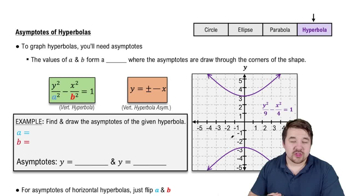
Asymptotes of Hyperbolas

Integration by Substitution

Integration by substitution involves changing variables to simplify an integral. By letting u equal an inner function (e.g., u = x/2 + ln 5), the integral can be rewritten in terms of u, making it easier to evaluate.
Recommended video:
04:27
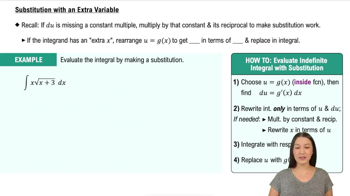
Substitution With an Extra Variable

Linearity of Integration

The linearity property states that constants can be factored out of integrals and sums of functions can be integrated term-by-term. This allows the constant 3 to be factored out, simplifying the integral before applying substitution.
Recommended video:
07:17
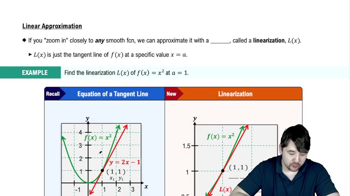
Linearization