
Textbook Question
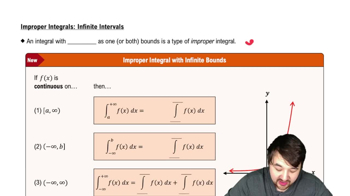
The integrals in Exercises 1–34 converge. Evaluate the integrals without using tables.
∫₀² (s + 1) / √(4 − s²) ds
1
views

 Verified step by step guidance
 11:11
11:11
 07:32
07:32 08:01
08:01The integrals in Exercises 1–34 converge. Evaluate the integrals without using tables.
∫₀² (s + 1) / √(4 − s²) ds
The integrals in Exercises 1–44 are in no particular order. Evaluate each integral using any algebraic method, trigonometric identity, or substitution you think is appropriate.
∫ 3 sinh(x/2 + ln 5) dx
The integrals in Exercises 1–34 converge. Evaluate the integrals without using tables.
∫₋∞² (2 dx) / (x² + 4)
Evaluate the integrals in Exercises 31–56. Some integrals do not require integration by parts.
∫ (cos(√x))/(√x) dx
The integrals in Exercises 1–44 are in no particular order. Evaluate each integral using any algebraic method, trigonometric identity, or substitution you think is appropriate.
∫ (x + 2√(x - 1)) / (2x√(x - 1)) dx
Annual rainfall The annual rainfall in inches for San Francisco, California, is approximately a normal random variable with mean 20.11 in. and standard deviation 4.7 in. What is the probability that next year’s rainfall will exceed 17 in.?