Ch. 8 - Techniques of Integration
Hass - Thomas' Calculus 15th Edition
Hass15th EditionThomas' CalculusISBN: 9780137616077Not the one you use?Change textbook
Chapter 8, Problem 8.3.4

Evaluate the integrals in Exercises 1–22.
∫ sin⁴(2x) cos(2x) dx

Verified step by step guidance
1
Recognize that the integral involves powers of sine and cosine functions with the same argument, specifically \(\sin^4(2x)\) and \(\cos(2x)\). This suggests using a substitution related to the inner function of sine and cosine.
Let \(u = \sin(2x)\). Then, compute the differential \(du\): since \(\frac{d}{dx} \sin(2x) = 2 \cos(2x)\), it follows that \(du = 2 \cos(2x) \, dx\), or equivalently, \(\cos(2x) \, dx = \frac{du}{2}\).
Rewrite the integral in terms of \(u\) using the substitution: \(\int \sin^4(2x) \cos(2x) \, dx = \int u^4 \cdot \cos(2x) \, dx = \int u^4 \cdot \frac{du}{2} = \frac{1}{2} \int u^4 \, du\).
Integrate \(\frac{1}{2} \int u^4 \, du\) by applying the power rule for integration: \(\int u^n \, du = \frac{u^{n+1}}{n+1} + C\). So, \(\frac{1}{2} \int u^4 \, du = \frac{1}{2} \cdot \frac{u^5}{5} + C\).
Finally, substitute back \(u = \sin(2x)\) to express the answer in terms of \(x\): the integral becomes \(\frac{1}{10} \sin^5(2x) + C\).

Verified video answer for a similar problem:

This video solution was recommended by our tutors as helpful for the problem above.
Video duration:
1m
Was this helpful?

Key Concepts

Here are the essential concepts you must grasp in order to answer the question correctly.

Trigonometric Integration

Trigonometric integration involves techniques to integrate functions containing trigonometric expressions. It often requires using identities or substitutions to simplify powers or products of sine and cosine functions for easier integration.
Recommended video:
6:04
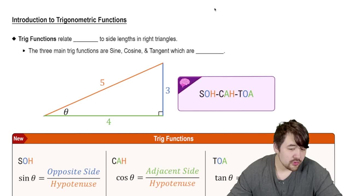
Introduction to Trigonometric Functions

Substitution Method

The substitution method simplifies integrals by changing variables. For integrals like ∫sin⁴(2x)cos(2x) dx, letting u = sin(2x) transforms the integral into a polynomial form in u, making it straightforward to integrate.
Recommended video:
07:33
Euler's Method

Power Reduction and Algebraic Manipulation

When integrating powers of trigonometric functions, expressing them in terms of lower powers or using algebraic manipulation helps. Recognizing that cos(2x) dx relates to the derivative of sin(2x) allows rewriting the integral in a simpler form.
Recommended video:
05:58
Intro to Power Series