
Ch. 8 - Techniques of Integration
Hass - Thomas' Calculus 15th Edition
Hass15th EditionThomas' CalculusISBN: 9780137616077Not the one you use?Change textbook
Chapter 8, Problem 8.2.70

In Exercises 67–73, use integration by parts to establish the reduction formula.
∫ (ln x)^n dx = x (ln x)^n - n ∫ (ln x)^(n-1) dx

Verified step by step guidance
1
Start with the integral \( I_n = \int (\ln x)^n \, dx \), where \( n \) is a positive integer.
Apply integration by parts by choosing \( u = (\ln x)^n \) and \( dv = dx \). Then, compute \( du \) and \( v \): - \( du = n (\ln x)^{n-1} \cdot \frac{1}{x} \, dx \) - \( v = x \)
Use the integration by parts formula: \[ \int u \, dv = uv - \int v \, du \] Substitute the expressions for \( u, v, du \) to get: \[ I_n = x (\ln x)^n - \int x \cdot n (\ln x)^{n-1} \cdot \frac{1}{x} \, dx \]
Simplify the integral inside: \[ I_n = x (\ln x)^n - n \int (\ln x)^{n-1} \, dx \]
This gives the reduction formula: \[ \int (\ln x)^n \, dx = x (\ln x)^n - n \int (\ln x)^{n-1} \, dx \]

Verified video answer for a similar problem:

This video solution was recommended by our tutors as helpful for the problem above.
Video duration:
4m
Was this helpful?

Key Concepts

Here are the essential concepts you must grasp in order to answer the question correctly.

Integration by Parts

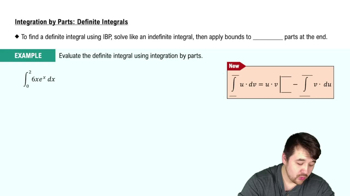
Integration by parts is a technique derived from the product rule of differentiation. It transforms the integral of a product of functions into simpler integrals, using the formula ∫u dv = uv - ∫v du. Choosing u and dv wisely is crucial to simplify the integral effectively.
Recommended video:
06:18
Integration by Parts for Definite Integrals

Reduction Formula

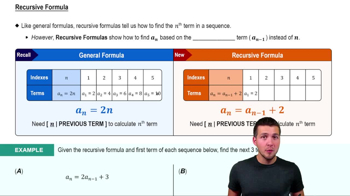
A reduction formula expresses an integral involving a power or parameter n in terms of a similar integral with a lower power or parameter (n-1). It helps solve complex integrals recursively by breaking them down into simpler cases.
Recommended video:
Guided course
5:59
Recursive Formulas

Logarithmic Functions and Their Derivatives

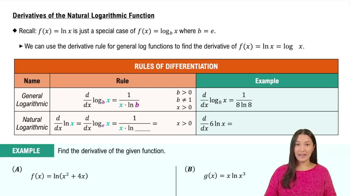
Understanding the properties and derivatives of logarithmic functions, especially ln(x), is essential. The derivative of ln(x) is 1/x, which plays a key role when applying integration by parts to integrals involving powers of ln(x).
Recommended video:
05:18
Derivative of the Natural Logarithmic Function