
Textbook Question
In Exercises 67–73, use integration by parts to establish the reduction formula.
∫ (ln x)^n dx = x (ln x)^n - n ∫ (ln x)^(n-1) dx

 Verified step by step guidance
 11:11
11:11
 09:25
09:25 07:45
07:45In Exercises 67–73, use integration by parts to establish the reduction formula.
∫ (ln x)^n dx = x (ln x)^n - n ∫ (ln x)^(n-1) dx
[Technology Exercise] When solving Exercises 33-40, you may need to use a calculator or a computer.
Find, to two decimal places, the areas of the surfaces generated by revolving the curves in Exercises 35 and 36 about the x-axis.
y = x²/4, 0 ≤ x ≤ 2
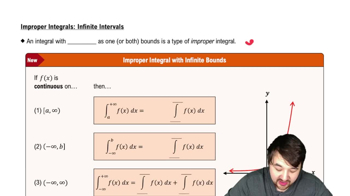
The integrals in Exercises 1–34 converge. Evaluate the integrals without using tables.
∫₀^∞ (16 tan⁻¹x dx) / (1 + x²)
In Exercises 35–68, use integration, the Direct Comparison Test, or the Limit Comparison Test to test the integrals for convergence. If more than one method applies, use whatever method you prefer.
∫ from 2 to ∞ of (dx / √(x² - 1))
Evaluate the integrals in Exercises 23–32.
∫₀^(π/6) √(1 + sin(x)) dx
(Hint: Multiply by √((1 - sin(x)) / (1 - sin(x))))
Exercises 83–86 are about the infinite region in the first quadrant between the curve y = e^(-x) and the x-axis.
86. Find the volume of the solid generated by revolving the region about the x-axis.