
Ch. 8 - Techniques of Integration
Hass - Thomas' Calculus 15th Edition
Hass15th EditionThomas' CalculusISBN: 9780137616077Not the one you use?Change textbook
Chapter 8, Problem 8.7.18b

In Exercises 11–22, estimate the minimum number of subintervals needed to approximate the integrals with an error of magnitude less than 10^-4 by (b) Simpson’s Rule. (The integrals in Exercises 11–18 are the integrals from Exercises 1–8.)
∫ from 2 to 4 of 1/(s - 1)² ds

Verified step by step guidance
1
Identify the function to be integrated: \(f(s) = \frac{1}{(s - 1)^2}\), and the interval of integration is from \(a = 2\) to \(b = 4\).
Recall the error bound formula for Simpson's Rule: the error \(E_S\) satisfies \(|E_S| \leq \frac{(b - a)^5}{180 n^4} \max_{a \leq s \leq b} |f^{(4)}(s)|\), where \(n\) is the number of subintervals (which must be even), and \(f^{(4)}(s)\) is the fourth derivative of \(f\).
Compute the fourth derivative \(f^{(4)}(s)\) of the function \(f(s) = (s - 1)^{-2}\). This involves differentiating \(f(s)\) four times with respect to \(s\).
Determine the maximum value of \(|f^{(4)}(s)|\) on the interval \([2, 4]\). Since \(f^{(4)}(s)\) is continuous on this interval, evaluate it at critical points and endpoints to find the maximum.
Set the error bound less than the desired tolerance \(10^{-4}\) and solve for \(n\): \(\frac{(4 - 2)^5}{180 n^4} \max |f^{(4)}(s)| < 10^{-4}\). Rearrange to find \(n > \left( \frac{(4 - 2)^5 \max |f^{(4)}(s)|}{180 \times 10^{-4}} \right)^{1/4}\). Choose the smallest even integer \(n\) that satisfies this inequality.

Verified video answer for a similar problem:

This video solution was recommended by our tutors as helpful for the problem above.
Video duration:
11m
Was this helpful?

Key Concepts

Here are the essential concepts you must grasp in order to answer the question correctly.

Simpson's Rule

Simpson's Rule is a numerical method for approximating definite integrals by dividing the interval into an even number of subintervals and fitting quadratic polynomials to the function. It generally provides more accurate results than the trapezoidal or midpoint rules for smooth functions.
Recommended video:

Error Bound for Simpson's Rule

The error bound for Simpson's Rule depends on the fourth derivative of the integrand. Specifically, the error magnitude is at most (K(b - a)^5) / (180 n^4), where K is the maximum absolute value of the fourth derivative on [a, b], and n is the number of subintervals. This formula helps estimate the minimum n needed for a desired accuracy.
Recommended video:
04:57
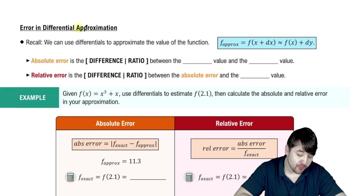
Determining Error and Relative Error

Fourth Derivative of the Integrand

To apply the error bound, one must find or estimate the maximum absolute value of the fourth derivative of the function on the interval. For the function 1/(s - 1)^2, this involves differentiating four times and analyzing the behavior on [2, 4] to determine the constant K used in the error estimate.
Recommended video:
05:22
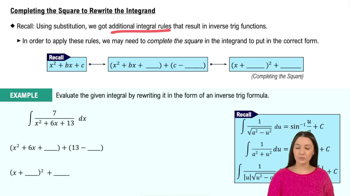
Completing the Square to Rewrite the Integrand