
Ch. 8 - Techniques of Integration
Hass - Thomas' Calculus 15th Edition
Hass15th EditionThomas' CalculusISBN: 9780137616077Not the one you use?Change textbook
Chapter 8, Problem 8.2.58b

Finding area
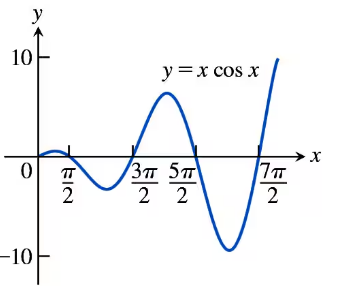
Find the area of the region enclosed by the curve y = x cos(x) and the x-axis (see the accompanying figure) for:
b. 3π/2 ≤ x ≤ 5π/2.
Graph of y = x cos(x) from 0 to 7π/2 showing oscillations crossing the x-axis between 3π/2 and 5π/2.

Verified step by step guidance
1
Identify the region bounded by the curve \(y = x \cos(x)\) and the x-axis for the interval \(\frac{3\pi}{2} \leq x \leq \frac{5\pi}{2}\). Notice from the graph that the curve crosses the x-axis at \(x = \frac{3\pi}{2}\) and \(x = \frac{5\pi}{2}\), and the function is negative between these points.
Since the function is below the x-axis in this interval, the area between the curve and the x-axis is given by the integral of the absolute value of the function. This means we need to integrate \(-y = -x \cos(x)\) over \(\left[ \frac{3\pi}{2}, \frac{5\pi}{2} \right]\) to get a positive area.
Set up the integral for the area as \(\displaystyle A = \int_{\frac{3\pi}{2}}^{\frac{5\pi}{2}} -x \cos(x) \, dx\).
Use integration by parts to evaluate the integral. Let \(u = x\) and \(dv = \cos(x) dx\). Then, compute \(du = dx\) and \(v = \sin(x)\). Apply the integration by parts formula: \(\int u \, dv = uv - \int v \, du\).
After finding the antiderivative, evaluate it at the bounds \(x = \frac{5\pi}{2}\) and \(x = \frac{3\pi}{2}\), then subtract to find the definite integral value, which represents the area of the region.

Verified video answer for a similar problem:

This video solution was recommended by our tutors as helpful for the problem above.
Video duration:
5m
Was this helpful?

Key Concepts

Here are the essential concepts you must grasp in order to answer the question correctly.

Definite Integral for Area Calculation

The definite integral of a function over an interval gives the net area between the curve and the x-axis. When the function crosses the x-axis, the integral sums positive and negative areas, so to find the total enclosed area, you must consider the absolute value or split the integral at zeros.
Recommended video:
05:43
Definition of the Definite Integral

Finding Zeros of the Function

To determine the area enclosed by the curve and the x-axis, it is essential to find where the function crosses the x-axis (i.e., where y = 0). For y = x cos(x), zeros occur when cos(x) = 0 or x = 0, which helps in splitting the integral into intervals where the function is positive or negative.
Recommended video:
Guided course
6:37
Zero and Negative Rules

Properties of the Function y = x cos(x)

The function y = x cos(x) oscillates with increasing amplitude as x increases, crossing the x-axis multiple times. Understanding its behavior between 3π/2 and 5π/2, including the sign of the function, is crucial for correctly setting up the integral to find the enclosed area.
Recommended video:
06:21
Properties of Functions