
Ch. 8 - Techniques of Integration
Hass - Thomas' Calculus 15th Edition
Hass15th EditionThomas' CalculusISBN: 9780137616077Not the one you use?Change textbook
Chapter 8, Problem 8.8.89b

89. Consider the infinite region in the first quadrant bounded by the graphs of
y = 1 / x², y = 0, and x = 1.
b. Find the volume of the solid formed by revolving the region (i) about the x-axis.

Verified step by step guidance
1
Identify the region to be revolved: it is bounded by the curve \(y = \frac{1}{x^2}\), the x-axis (\(y=0\)), and the vertical line \(x=1\), in the first quadrant. Since the region is in the first quadrant, \(x\) ranges from 1 to infinity.
Set up the volume integral using the disk method because the region is revolved around the x-axis. The radius of each disk is the distance from the x-axis to the curve, which is \(r(x) = \frac{1}{x^2}\).
Write the volume integral as \(V = \pi \int_{1}^{\infty} \left(r(x)\right)^2 \, dx = \pi \int_{1}^{\infty} \left(\frac{1}{x^2}\right)^2 \, dx\).
Simplify the integrand: \(\left(\frac{1}{x^2}\right)^2 = \frac{1}{x^4}\), so the integral becomes \(V = \pi \int_{1}^{\infty} \frac{1}{x^4} \, dx\).
Evaluate the improper integral by finding the antiderivative of \(x^{-4}\), then take the limit as the upper bound approaches infinity to determine the volume.

Verified video answer for a similar problem:

This video solution was recommended by our tutors as helpful for the problem above.
Video duration:
4m
Was this helpful?

Key Concepts

Here are the essential concepts you must grasp in order to answer the question correctly.

Definite Integrals for Area and Volume

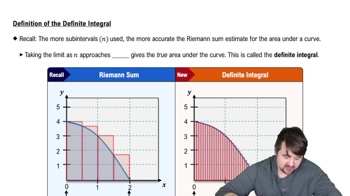
Definite integrals calculate the accumulation of quantities, such as area under a curve or volume of solids. In volume problems, integrals sum infinitesimal cross-sectional areas along an axis to find total volume. Setting correct limits and integrand expressions is essential.
Recommended video:
05:43
Definition of the Definite Integral

Method of Disks/Washers for Volumes of Revolution

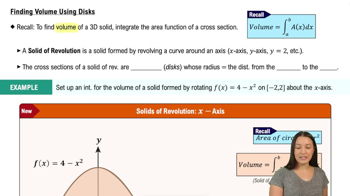
The disk/washer method finds volumes by slicing the solid perpendicular to the axis of revolution. Each slice forms a disk or washer whose area is integrated along the axis. For revolution about the x-axis, the radius is the function value, and volume is π∫[radius]^2 dx.
Recommended video:
04:48
Finding Volume Using Disks

Understanding the Region and Boundaries

Identifying the region bounded by y = 1/x², y = 0, and x = 1 in the first quadrant is crucial. This defines the limits of integration and the shape being revolved. Recognizing that the region extends from x=1 to infinity helps set proper integral bounds for volume calculation.
Recommended video:
07:45
Area of Polar Regions