Ch. 7 - Transcendental Functions
Hass - Thomas' Calculus 15th Edition
Hass15th EditionThomas' CalculusISBN: 9780137616077Not the one you use?Change textbook
Chapter 7, Problem 7.2.12

In Exercises 7–38, find the derivative of y with respect to x, t, or θ, as appropriate.
12. y = ln(10/x)

Verified step by step guidance
1
Recognize that the function is given as \(y = \ln\left(\frac{10}{x}\right)\), which is a natural logarithm of a quotient.
Use the logarithm property that \(\ln\left(\frac{a}{b}\right) = \ln(a) - \ln(b)\) to rewrite the function as \(y = \ln(10) - \ln(x)\).
Note that \(\ln(10)\) is a constant since 10 is a constant, so its derivative with respect to \(x\) is zero.
Recall the derivative of \(\ln(x)\) with respect to \(x\) is \(\frac{1}{x}\), so the derivative of \(-\ln(x)\) is \(-\frac{1}{x}\).
Combine these results to write the derivative \(\frac{dy}{dx} = 0 - \frac{1}{x} = -\frac{1}{x}\).

Verified video answer for a similar problem:

This video solution was recommended by our tutors as helpful for the problem above.
Video duration:
2m

Key Concepts

Here are the essential concepts you must grasp in order to answer the question correctly.

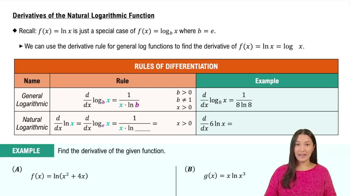
Derivative of the Natural Logarithm Function

The derivative of ln(u), where u is a differentiable function of x, is (1/u) times the derivative of u. This rule allows us to differentiate logarithmic functions by applying the chain rule to the inner function.
Recommended video:
05:18
Derivative of the Natural Logarithmic Function

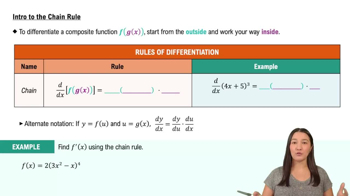
Chain Rule

The chain rule is used to differentiate composite functions. It states that the derivative of a function composed of another function is the derivative of the outer function evaluated at the inner function times the derivative of the inner function.
Recommended video:
05:02
Intro to the Chain Rule

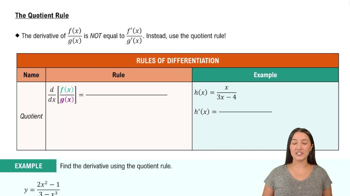
Derivative of a Quotient

When differentiating a function expressed as a quotient, such as 10/x, it can be rewritten as 10x⁻¹. Differentiating powers of x involves applying the power rule, which states that d/dx of x^n is n*x^(n-1).
Recommended video:
06:43
The Quotient Rule