Ch. 7 - Transcendental Functions
Hass - Thomas' Calculus 15th Edition
Hass15th EditionThomas' CalculusISBN: 9780137616077Not the one you use?Change textbook
Chapter 7, Problem 7.6.11

Find the values in Exercises 9–12.
11. tan(arcsin(-1/2))

Verified step by step guidance
1
Recognize that the expression is \( \tan(\arcsin(-\frac{1}{2})) \). Here, \( \arcsin(-\frac{1}{2}) \) represents an angle \( \theta \) such that \( \sin(\theta) = -\frac{1}{2} \).
Let \( \theta = \arcsin(-\frac{1}{2}) \). Since \( \sin(\theta) = -\frac{1}{2} \), we want to find \( \tan(\theta) \). Recall that \( \tan(\theta) = \frac{\sin(\theta)}{\cos(\theta)} \).
Use the Pythagorean identity to find \( \cos(\theta) \): \( \cos(\theta) = \pm \sqrt{1 - \sin^2(\theta)} = \pm \sqrt{1 - \left(-\frac{1}{2}\right)^2} = \pm \sqrt{1 - \frac{1}{4}} = \pm \sqrt{\frac{3}{4}} = \pm \frac{\sqrt{3}}{2} \).
Determine the correct sign of \( \cos(\theta) \) by considering the range of \( \arcsin \), which is \( \left[-\frac{\pi}{2}, \frac{\pi}{2}\right] \). In this interval, cosine is positive for angles where sine is negative, so \( \cos(\theta) = \frac{\sqrt{3}}{2} \).
Finally, compute \( \tan(\theta) = \frac{\sin(\theta)}{\cos(\theta)} = \frac{-\frac{1}{2}}{\frac{\sqrt{3}}{2}} = -\frac{1}{\sqrt{3}} \).

Verified video answer for a similar problem:

This video solution was recommended by our tutors as helpful for the problem above.
Video duration:
3m
Was this helpful?

Key Concepts

Here are the essential concepts you must grasp in order to answer the question correctly.

Inverse Trigonometric Functions

Inverse trigonometric functions, like arcsin, return the angle whose trigonometric ratio equals a given value. For example, arcsin(-1/2) gives the angle θ in the range [-π/2, π/2] such that sin(θ) = -1/2.
Recommended video:
06:35
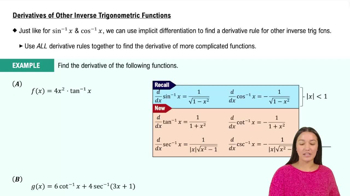
Derivatives of Other Inverse Trigonometric Functions

Relationship Between Sine and Tangent

To find tan(arcsin(x)), use the identity tan(θ) = sin(θ)/cos(θ). Knowing sin(θ), you can find cos(θ) using the Pythagorean identity cos²(θ) = 1 - sin²(θ), then compute the tangent.
Recommended video:
05:13
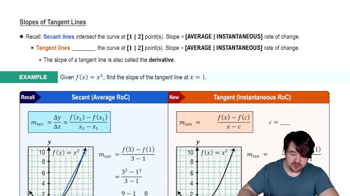
Slopes of Tangent Lines

Pythagorean Identity

The Pythagorean identity states that sin²(θ) + cos²(θ) = 1 for any angle θ. This allows calculation of one trigonometric function if the other is known, essential for evaluating expressions like tan(arcsin(x)).
Recommended video:
7:17
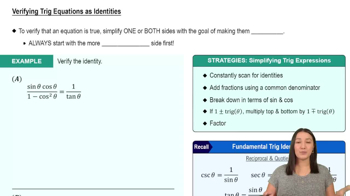
Verifying Trig Equations as Identities