Ch. 7 - Transcendental Functions
Hass - Thomas' Calculus 15th Edition
Hass15th EditionThomas' CalculusISBN: 9780137616077Not the one you use?Change textbook
Chapter 7, Problem 7.6.55

Evaluate the integrals in Exercises 53–76.
55. ∫dx/(17+x²)

Verified step by step guidance
1
Recognize that the integral \( \int \frac{dx}{17 + x^2} \) is of the form \( \int \frac{dx}{a^2 + x^2} \), which is a standard integral that results in an arctangent function.
Identify \( a^2 = 17 \), so \( a = \sqrt{17} \). This allows us to rewrite the integral as \( \int \frac{dx}{(\sqrt{17})^2 + x^2} \).
Recall the formula for the integral: \( \int \frac{dx}{a^2 + x^2} = \frac{1}{a} \arctan\left( \frac{x}{a} \right) + C \), where \( C \) is the constant of integration.
Apply the formula by substituting \( a = \sqrt{17} \) into the expression, giving \( \frac{1}{\sqrt{17}} \arctan\left( \frac{x}{\sqrt{17}} \right) + C \).
Write the final answer as the integral evaluated, including the constant of integration \( C \).

Verified video answer for a similar problem:

This video solution was recommended by our tutors as helpful for the problem above.
Video duration:
2m
Was this helpful?

Key Concepts

Here are the essential concepts you must grasp in order to answer the question correctly.

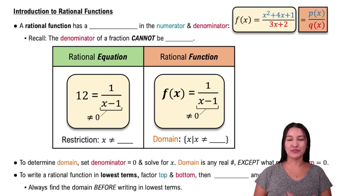
Integration of Rational Functions

This involves integrating functions expressed as ratios of polynomials. Recognizing the form of the integrand helps in choosing the appropriate method, such as substitution or partial fractions, to simplify and evaluate the integral.
Recommended video:
6:04
Intro to Rational Functions

Integral of the Form ∫dx/(a² + x²)

Integrals of the form ∫dx/(a² + x²) have a standard solution: (1/a) arctangent(x/a) + C. This formula is essential for evaluating integrals where the denominator is a sum of a constant squared and the variable squared.
Recommended video:
03:39
Integrals of Natural Exponential Functions (e^x)

Arctangent Function and Its Properties

The arctangent function, denoted arctan(x), is the inverse of the tangent function. It arises naturally in integrals involving 1/(a² + x²), and understanding its derivative and behavior is key to correctly applying integration formulas.
Recommended video:
06:21
Properties of Functions