Ch. 7 - Transcendental Functions
Hass - Thomas' Calculus 15th Edition
Hass15th EditionThomas' CalculusISBN: 9780137616077Not the one you use?Change textbook
Chapter 7, Problem 7.3.143

143.
b. Find the average value of ln(x) over [1, e].

Verified step by step guidance
1
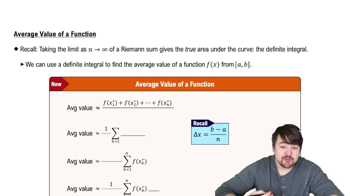
Recall the formula for the average value of a function \(f(x)\) over the interval \([a, b]\): \[\text{Average value} = \frac{1}{b - a} \int_a^b f(x) \, dx\]
Identify the function and interval: here, \(f(x) = \ln(x)\), \(a = 1\), and \(b = e\).
Set up the integral for the average value: \[\frac{1}{e - 1} \int_1^e \ln(x) \, dx\]
To evaluate the integral \(\int \ln(x) \, dx\), use integration by parts. Let \(u = \ln(x)\) so that \(du = \frac{1}{x} dx\), and let \(dv = dx\) so that \(v = x\).
Apply integration by parts formula: \[\int u \, dv = uv - \int v \, du\] which gives \[\int \ln(x) \, dx = x \ln(x) - \int x \cdot \frac{1}{x} \, dx = x \ln(x) - \int 1 \, dx = x \ln(x) - x + C\] Use this to evaluate the definite integral from 1 to \(e\) and then substitute back into the average value formula.

Verified video answer for a similar problem:

This video solution was recommended by our tutors as helpful for the problem above.
Video duration:
3m
Was this helpful?

Key Concepts

Here are the essential concepts you must grasp in order to answer the question correctly.

Average Value of a Function

The average value of a continuous function f(x) over an interval [a, b] is given by (1/(b - a)) times the integral of f(x) from a to b. It represents the mean height of the function on that interval.
Recommended video:
06:37
Average Value of a Function

Definite Integral

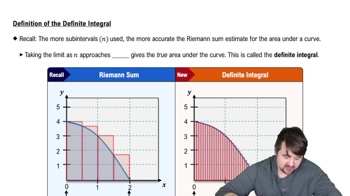
A definite integral calculates the net area under the curve of a function between two points a and b. It is essential for finding accumulated quantities, such as total area or average values over intervals.
Recommended video:
05:43
Definition of the Definite Integral

Integration of the Natural Logarithm Function

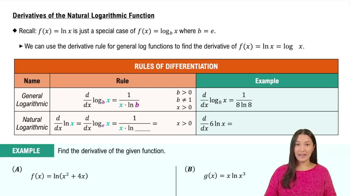
Integrating ln(x) requires integration by parts, using u = ln(x) and dv = dx. The integral of ln(x) is x ln(x) - x + C, which is crucial for evaluating the definite integral of ln(x) over [1, e].
Recommended video:
05:18
Derivative of the Natural Logarithmic Function