Ch. 7 - Transcendental Functions
Hass - Thomas' Calculus 15th Edition
Hass15th EditionThomas' CalculusISBN: 9780137616077Not the one you use?Change textbook
Chapter 7, Problem 7.6.17

Find the limits in Exercises 13–20. (If in doubt, look at the function’s graph.)
17. lim(x→∞)arcsec(x)

Verified step by step guidance
1
Recall the definition of the arcsecant function: \(\mathrm{arcsec}(x)\) is the inverse of the secant function, so \(y = \mathrm{arcsec}(x)\) means \(x = \sec(y)\).
Understand the domain and range of \(\mathrm{arcsec}(x)\). The domain is \(|x| \geq 1\), and the principal range is \([0, \pi]\) excluding \(\frac{\pi}{2}\), where \(\sec(y)\) is defined.
As \(x \to \infty\), consider what happens to \(y\) such that \(x = \sec(y)\). Since \(\sec(y) = \frac{1}{\cos(y)}\), large values of \(x\) correspond to \(\cos(y)\) approaching zero from the positive side.
Identify the angle \(y\) in \([0, \pi]\) where \(\cos(y)\) approaches zero from the positive side. This angle is \(\frac{\pi}{2}\), but note that \(\sec(y)\) is not defined exactly at \(\frac{\pi}{2}\), so we approach it from the left or right.
Conclude that as \(x \to \infty\), \(\mathrm{arcsec}(x)\) approaches \(\frac{\pi}{2}\) from the appropriate side, so the limit is \(\lim_{x \to \infty} \mathrm{arcsec}(x) = \frac{\pi}{2}\).

Verified video answer for a similar problem:

This video solution was recommended by our tutors as helpful for the problem above.
Video duration:
2m
Was this helpful?

Key Concepts

Here are the essential concepts you must grasp in order to answer the question correctly.

Limit of a Function as x Approaches Infinity

This concept involves understanding the behavior of a function as the input variable x grows without bound. It helps determine the value that the function approaches, if any, when x becomes very large. Limits at infinity are essential for analyzing end behavior of functions.
Recommended video:
06:11
Limits of Rational Functions: Denominator = 0

Definition and Domain of the Arcsecant Function

The arcsecant function, denoted arcsec(x), is the inverse of the secant function restricted to its principal branch. Its domain is |x| ≥ 1, and it returns an angle whose secant is x. Knowing its domain and range is crucial for evaluating limits involving arcsec.
Recommended video:
05:43
Definition of the Definite Integral

Behavior of the Secant and Arcsecant Functions at Infinity

As x approaches infinity, the secant function's inverse, arcsec(x), approaches a specific angle. Understanding how sec(θ) behaves and how arcsec(x) relates to θ helps find the limit. Typically, arcsec(x) approaches π/2 as x → ∞ because sec(π/2) is undefined but the limit from the right approaches infinity.
Recommended video:
6:22
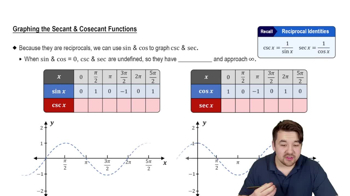
Graphs of Secant and Cosecant Functions