Ch. 7 - Transcendental Functions
Hass - Thomas' Calculus 15th Edition
Hass15th EditionThomas' CalculusISBN: 9780137616077Not the one you use?Change textbook
Chapter 7, Problem 7.3.87

Evaluate the integrals in Exercises 87–96.
87. ∫ 5ˣ dx

Verified step by step guidance
1
Recognize that the integral involves an exponential function with base 5, which can be written as \$5^x$.
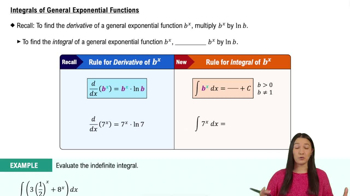
Recall the general formula for integrating an exponential function with base \(a\): \(\int a^x \, dx = \frac{a^x}{\ln(a)} + C\), where \(a > 0\) and \(a \neq 1\).
Apply this formula to the integral \(\int 5^x \, dx\), substituting \(a = 5\).
Write the integral as \(\int 5^x \, dx = \frac{5^x}{\ln(5)} + C\), where \(C\) is the constant of integration.
This expression represents the antiderivative of \$5^x$.

Verified video answer for a similar problem:

This video solution was recommended by our tutors as helpful for the problem above.
Video duration:
55s
Was this helpful?

Key Concepts

Here are the essential concepts you must grasp in order to answer the question correctly.

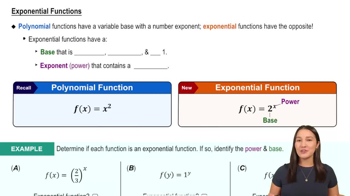
Exponential Functions

An exponential function has the form f(x) = a^x, where the base a is a positive constant. Understanding how these functions behave and their properties is essential for integrating expressions like 5^x.
Recommended video:
6:13
Exponential Functions

Integration of Exponential Functions

The integral of an exponential function a^x with respect to x is (a^x) / ln(a) + C, where ln(a) is the natural logarithm of the base. This formula is crucial for solving integrals involving exponential terms.
Recommended video:
05:11
Integrals of General Exponential Functions

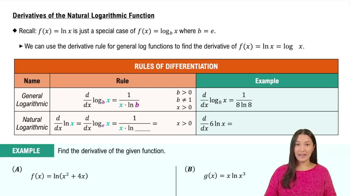
Natural Logarithm (ln)

The natural logarithm ln(x) is the inverse of the exponential function e^x. It appears in the integration formula of exponential functions and is important for simplifying and understanding the results of such integrals.
Recommended video:
05:18
Derivative of the Natural Logarithmic Function