Ch. 7 - Transcendental Functions
Hass - Thomas' Calculus 15th Edition
Hass15th EditionThomas' CalculusISBN: 9780137616077Not the one you use?Change textbook
Chapter 7, Problem 7.2.59

In Exercises 57–70, use logarithmic differentiation to find the derivative of y with respect to the given independent variable.
59. y = √(t/(t+1))

Verified step by step guidance
1
Start by expressing the function in a form that is easier to differentiate using logarithmic differentiation. Given \( y = \sqrt{\frac{t}{t+1}} \), rewrite it as \( y = \left( \frac{t}{t+1} \right)^{\frac{1}{2}} \).
Take the natural logarithm of both sides to apply logarithmic differentiation: \( \ln y = \ln \left( \left( \frac{t}{t+1} \right)^{\frac{1}{2}} \right) \).
Use the logarithm power rule to bring down the exponent: \( \ln y = \frac{1}{2} \ln \left( \frac{t}{t+1} \right) \).
Apply the logarithm quotient rule to separate the terms inside the logarithm: \( \ln y = \frac{1}{2} ( \ln t - \ln (t+1) ) \).
Differentiate both sides with respect to \( t \). Remember that \( \frac{d}{dt} (\ln y) = \frac{1}{y} \frac{dy}{dt} \) by the chain rule. Then differentiate the right side term-by-term using the derivative of \( \ln t \) and \( \ln (t+1) \).

Verified video answer for a similar problem:

This video solution was recommended by our tutors as helpful for the problem above.
Video duration:
5m
Was this helpful?

Key Concepts

Here are the essential concepts you must grasp in order to answer the question correctly.

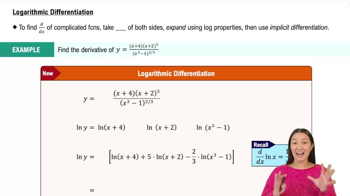
Logarithmic Differentiation

Logarithmic differentiation involves taking the natural logarithm of both sides of an equation y = f(x) to simplify the differentiation process, especially for functions involving products, quotients, or powers. After applying the log, implicit differentiation is used to find dy/dx, making complex derivatives easier to handle.
Recommended video:
06:30
Logarithmic Differentiation

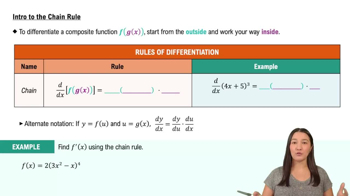
Chain Rule

The chain rule is a fundamental differentiation technique used when dealing with composite functions. It states that the derivative of a composite function is the derivative of the outer function evaluated at the inner function times the derivative of the inner function. This is essential when differentiating expressions like square roots or powers.
Recommended video:
05:02
Intro to the Chain Rule

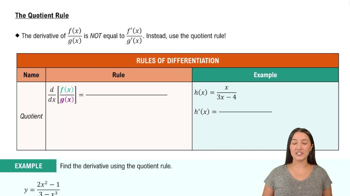
Quotient Rule and Simplification

The quotient rule is used to differentiate functions expressed as a ratio of two differentiable functions. It states that the derivative of f(x)/g(x) is (g(x)f'(x) - f(x)g'(x)) / [g(x)]². In logarithmic differentiation, recognizing the quotient inside the logarithm helps simplify the derivative by converting division into subtraction.
Recommended video:
06:43
The Quotient Rule