
Ch. 7 - Transcendental Functions
Hass - Thomas' Calculus 15th Edition
Hass15th EditionThomas' CalculusISBN: 9780137616077Not the one you use?Change textbook
Chapter 7, Problem 7.6.59

Evaluate the integrals in Exercises 53–76.
59. ∫(from 0 to 1)4ds/√(4-s²)

Verified step by step guidance
1
Recognize that the integral is of the form \(\int \frac{4}{\sqrt{4 - s^2}} \, ds\) from \(0\) to \(1\). This resembles the integral of a function involving \(\sqrt{a^2 - s^2}\), where \(a=2\) because \(4 = 2^2\).
Recall the standard integral formula: \(\int \frac{1}{\sqrt{a^2 - x^2}} \, dx = \arcsin\left(\frac{x}{a}\right) + C\). Since the numerator here is \(4\), factor it out to write the integral as \(4 \int \frac{1}{\sqrt{4 - s^2}} \, ds\).
Apply the formula to the integral inside: \(\int \frac{1}{\sqrt{4 - s^2}} \, ds = \arcsin\left(\frac{s}{2}\right) + C\).
Evaluate the definite integral by substituting the limits \(s=0\) and \(s=1\) into \(4 \arcsin\left(\frac{s}{2}\right)\), i.e., compute \(4 \left[ \arcsin\left(\frac{1}{2}\right) - \arcsin(0) \right]\).
Use known values of the arcsine function to express the result in terms of radians (e.g., \(\arcsin(0) = 0\) and \(\arcsin(\frac{1}{2}) = \frac{\pi}{6}\)), but do not calculate the final numeric value as per instructions.

Verified video answer for a similar problem:

This video solution was recommended by our tutors as helpful for the problem above.
Video duration:
1m
Was this helpful?

Key Concepts

Here are the essential concepts you must grasp in order to answer the question correctly.

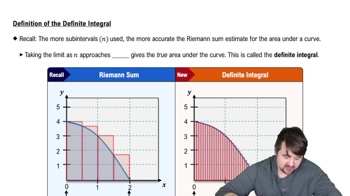
Definite Integral

A definite integral calculates the net area under a curve between two specified limits. It is represented as ∫ from a to b of f(x) dx, where a and b are the lower and upper bounds. Evaluating a definite integral involves finding the antiderivative and then applying the Fundamental Theorem of Calculus.
Recommended video:
05:43
Definition of the Definite Integral

Integration of Functions Involving Square Roots

Integrals containing expressions like √(a² - x²) often require trigonometric substitution or recognition of standard integral forms. These integrals relate to inverse trigonometric functions, such as arcsin or arccos, which simplify the evaluation process.
Recommended video:
07:01
Integrals Involving Natural Logs: Substitution

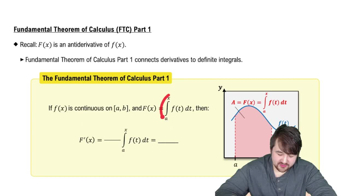
Fundamental Theorem of Calculus

This theorem connects differentiation and integration, stating that if F is an antiderivative of f on [a, b], then ∫ from a to b of f(x) dx = F(b) - F(a). It allows evaluation of definite integrals by computing the difference of antiderivative values at the bounds.
Recommended video:
06:11
Fundamental Theorem of Calculus Part 1