Ch. 7 - Transcendental Functions
Hass - Thomas' Calculus 15th Edition
Hass15th EditionThomas' CalculusISBN: 9780137616077Not the one you use?Change textbook
Chapter 7, Problem 7.7.33

In Exercises 25–36, find the derivative of y with respect to the appropriate variable.
33. y = csch⁻¹(1/2)^θ

Verified step by step guidance
1
Identify the function given: \(y = \csch^{-1} \left( \frac{1}{2} \right)^\theta\). Notice that \(\csch^{-1} \left( \frac{1}{2} \right)\) is a constant since it does not depend on \(\theta\).
Rewrite the function to clarify the structure: \(y = \left( \csch^{-1} \left( \frac{1}{2} \right) \right)^\theta\). This is an exponential function with a constant base and variable exponent.
Recall the derivative formula for an exponential function with a constant base \(a\) and variable exponent \(x\): \(\frac{d}{dx} a^x = a^x \ln(a)\).
Apply the derivative formula to \(y\): \(\frac{dy}{d\theta} = \left( \csch^{-1} \left( \frac{1}{2} \right) \right)^\theta \cdot \ln \left( \csch^{-1} \left( \frac{1}{2} \right) \right)\).
This expression represents the derivative of \(y\) with respect to \(\theta\). You can leave the answer in this form or evaluate \(\csch^{-1} \left( \frac{1}{2} \right)\) if needed.

Verified video answer for a similar problem:

This video solution was recommended by our tutors as helpful for the problem above.
Video duration:
3m
Was this helpful?

Key Concepts

Here are the essential concepts you must grasp in order to answer the question correctly.

Inverse Hyperbolic Cosecant Function (csch⁻¹)

The inverse hyperbolic cosecant function, denoted csch⁻¹(x), is the inverse of the hyperbolic cosecant function. It returns the value whose hyperbolic cosecant is x. Understanding its definition and domain is essential for differentiating expressions involving csch⁻¹.
Recommended video:
06:35
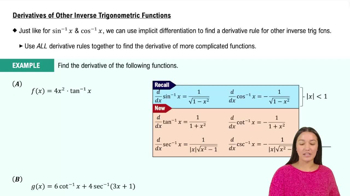
Derivatives of Other Inverse Trigonometric Functions

Chain Rule

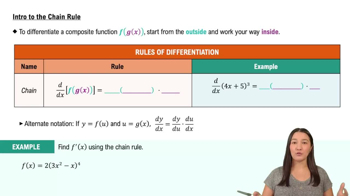
The chain rule is a fundamental differentiation technique used when dealing with composite functions. It states that the derivative of a composite function is the derivative of the outer function evaluated at the inner function times the derivative of the inner function. This is crucial when differentiating functions like csch⁻¹(1/2)^θ.
Recommended video:
05:02
Intro to the Chain Rule

Derivative of Inverse Hyperbolic Functions

Each inverse hyperbolic function has a specific derivative formula. For csch⁻¹(x), the derivative with respect to x is -1/(|x|√(1+x²)). Knowing this formula allows you to differentiate expressions involving csch⁻¹ accurately.
Recommended video:
06:35
Derivatives of Other Inverse Trigonometric Functions