Ch. 7 - Transcendental Functions
Hass - Thomas' Calculus 15th Edition
Hass15th EditionThomas' CalculusISBN: 9780137616077Not the one you use?Change textbook
Chapter 7, Problem 7.5.3

In Exercises 1–6, use l’Hôpital’s Rule to evaluate the limit. Then evaluate the limit using a method studied in Chapter 2.


3. lim (x → ∞) (5x² - 3x) / (7x² + 1)

Verified step by step guidance
1
Identify the limit expression: \(\lim_{x \to \infty} \frac{5x^{2} - 3x}{7x^{2} + 1}\).
Check if the limit is an indeterminate form of type \(\frac{\infty}{\infty}\) by analyzing the degrees of the numerator and denominator as \(x\) approaches infinity.
Apply l'Hôpital's Rule by differentiating the numerator and denominator separately: differentiate \(5x^{2} - 3x\) to get \(10x - 3\), and differentiate \(7x^{2} + 1\) to get \$14x$.
Rewrite the limit using the derivatives: \(\lim_{x \to \infty} \frac{10x - 3}{14x}\), and analyze this new limit.
Alternatively, use algebraic simplification by dividing numerator and denominator by \(x^{2}\) (the highest power of \(x\) in the denominator) to simplify the expression and then evaluate the limit as \(x\) approaches infinity.

Verified video answer for a similar problem:

This video solution was recommended by our tutors as helpful for the problem above.
Video duration:
3m
Was this helpful?

Key Concepts

Here are the essential concepts you must grasp in order to answer the question correctly.

Limits at Infinity

Limits at infinity describe the behavior of a function as the input grows without bound. Understanding how polynomials behave for very large values of x helps determine the end behavior of rational functions, often simplifying the evaluation of limits as x approaches infinity.
Recommended video:
03:07
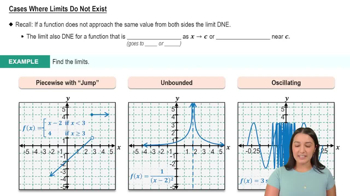
Cases Where Limits Do Not Exist

l’Hôpital’s Rule

l’Hôpital’s Rule is a method for evaluating limits that result in indeterminate forms like 0/0 or ∞/∞. It involves differentiating the numerator and denominator separately and then taking the limit of their quotient, which often simplifies the evaluation.
Recommended video:

Algebraic Simplification of Rational Functions

Algebraic simplification involves dividing numerator and denominator by the highest power of x present to simplify the expression. This method, studied in earlier calculus chapters, helps evaluate limits by reducing complex rational functions to simpler forms without using derivatives.
Recommended video:
06:11
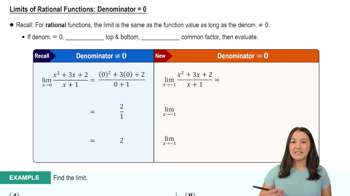
Limits of Rational Functions: Denominator = 0