Ch. 7 - Transcendental Functions
Hass - Thomas' Calculus 15th Edition
Hass15th EditionThomas' CalculusISBN: 9780137616077Not the one you use?Change textbook
Chapter 7, Problem 7.3.35

Evaluate the integrals in Exercises 33–54.
∫(from ln3 to ln2) (e^x) dx

Verified step by step guidance
1
Identify the integral to be evaluated: \(\int_{\ln 3}^{\ln 2} e^{x} \, dx\).
Recall the antiderivative of the integrand \(e^{x}\), which is \(e^{x}\) itself.
Apply the Fundamental Theorem of Calculus, which states that \(\int_{a}^{b} f(x) \, dx = F(b) - F(a)\), where \(F\) is an antiderivative of \(f\).
Substitute the limits of integration into the antiderivative: calculate \(e^{\ln 2} - e^{\ln 3}\).
Simplify the expressions using the property \(e^{\ln a} = a\) to rewrite the result in terms of numbers.

Verified video answer for a similar problem:

This video solution was recommended by our tutors as helpful for the problem above.
Video duration:
1m
Was this helpful?

Key Concepts

Here are the essential concepts you must grasp in order to answer the question correctly.

Definite Integral

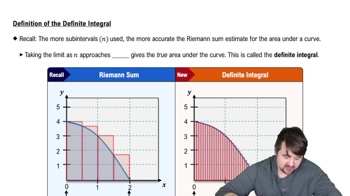
A definite integral calculates the net area under a curve between two specific limits. It is represented as ∫ from a to b of f(x) dx, where a and b are the lower and upper bounds. Evaluating a definite integral involves finding the antiderivative and then applying the Fundamental Theorem of Calculus.
Recommended video:
05:43
Definition of the Definite Integral

Antiderivative of the Exponential Function

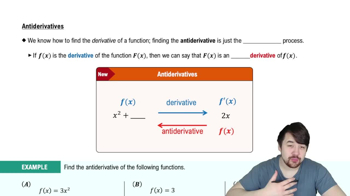
The antiderivative of e^x is e^x itself, since the derivative of e^x is e^x. This property simplifies integration of exponential functions, allowing direct substitution of the limits after integration.
Recommended video:
05:50
Antiderivatives

Properties of the Natural Logarithm

The natural logarithm ln(x) is the inverse of the exponential function e^x. Understanding that e^(ln a) = a helps simplify expressions when evaluating definite integrals with logarithmic limits, making it easier to compute exact values.
Recommended video:
05:36
Change of Base Property