Ch. 7 - Transcendental Functions
Hass - Thomas' Calculus 15th Edition
Hass15th EditionThomas' CalculusISBN: 9780137616077Not the one you use?Change textbook
Chapter 7, Problem 7.6.128

128. Derive the formula dy/dx = 1/(1+x²) for the derivative of y = arctan(x) by differentiating both sides of the equivalent equation tan(y)=x.

Verified step by step guidance
1
Start with the given equivalent equation: \(\tan(y) = x\). This relates \(y\) and \(x\) implicitly.
Differentiate both sides of the equation with respect to \(x\). Use implicit differentiation on the left side: \(\frac{d}{dx}[\tan(y)] = \frac{d}{dx}[x]\).
Apply the chain rule to the left side: \(\sec^2(y) \cdot \frac{dy}{dx} = 1\), since the derivative of \(\tan(y)\) with respect to \(y\) is \(\sec^2(y)\) and then multiply by \(\frac{dy}{dx}\).
Solve for \(\frac{dy}{dx}\) by dividing both sides by \(\sec^2(y)\): \(\frac{dy}{dx} = \frac{1}{\sec^2(y)}\).
Use the trigonometric identity \(\sec^2(y) = 1 + \tan^2(y)\) and substitute \(\tan(y) = x\) to rewrite the derivative as \(\frac{dy}{dx} = \frac{1}{1 + x^2}\).

Verified video answer for a similar problem:

This video solution was recommended by our tutors as helpful for the problem above.
Video duration:
5m
Was this helpful?

Key Concepts

Here are the essential concepts you must grasp in order to answer the question correctly.

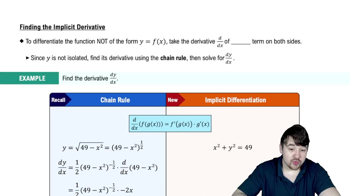
Implicit Differentiation

Implicit differentiation is a technique used to find the derivative of a function defined implicitly rather than explicitly. When y is given in terms of x through an equation like tan(y) = x, we differentiate both sides with respect to x, treating y as a function of x and applying the chain rule.
Recommended video:
05:14
Finding The Implicit Derivative

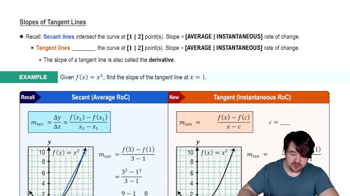
Derivative of the Tangent Function

The derivative of tan(y) with respect to y is sec²(y). This fact is essential when differentiating tan(y) implicitly, as it allows us to relate dy/dx to the derivative of tan(y) with respect to x by using the chain rule.
Recommended video:
05:13
Slopes of Tangent Lines

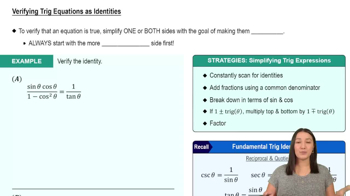
Trigonometric Identity for sec²(y)

The identity sec²(y) = 1 + tan²(y) helps simplify the derivative expression. Since tan(y) = x, substituting this into the identity allows us to express sec²(y) in terms of x, which is crucial for isolating dy/dx and deriving the formula dy/dx = 1/(1 + x²).
Recommended video:
7:17
Verifying Trig Equations as Identities