128. Derive the formula dy/dx = 1/(1+x²) for the derivative of y = arctan(x) by differentiating both sides of the equivalent equation tan(y)=x.

Ch. 7 - Transcendental Functions
Chapter 7, Problem 7.6.73
Evaluate the integrals in Exercises 53–76.
73. ∫(from 0 to ln√3) e^x dx/(1+e^(2x))
Verified step by step guidance1
Recognize the integral to evaluate: \(\int_0^{\ln \sqrt{3}} \frac{e^x}{1 + e^{2x}} \, dx\).
Make a substitution to simplify the integral. Let \(u = e^x\). Then, the differential is \(du = e^x \, dx\), which means \(e^x \, dx = du\).
Rewrite the integral in terms of \(u\). The limits change as follows: when \(x = 0\), \(u = e^0 = 1\); when \(x = \ln \sqrt{3}\), \(u = e^{\ln \sqrt{3}} = \sqrt{3}\). The integral becomes \(\int_1^{\sqrt{3}} \frac{1}{1 + u^2} \, du\).
Recognize that \(\int \frac{1}{1 + u^2} \, du\) is the standard integral for \(\arctan u + C\). So, the integral evaluates to \(\arctan u\) evaluated from \(1\) to \(\sqrt{3}\).
Apply the Fundamental Theorem of Calculus by substituting the limits back into \(\arctan u\) to express the definite integral as \(\arctan(\sqrt{3}) - \arctan(1)\).

Verified video answer for a similar problem:
This video solution was recommended by our tutors as helpful for the problem above.
Video duration:
4mWas this helpful?
Key Concepts
Here are the essential concepts you must grasp in order to answer the question correctly.
Definite Integrals
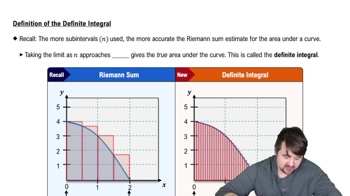
A definite integral calculates the net area under a curve between two specific limits. It involves evaluating the antiderivative at the upper and lower bounds and subtracting these values. This concept is essential for solving integrals with given limits, such as from 0 to ln(√3).
Recommended video:
Definition of the Definite Integral
Substitution Method
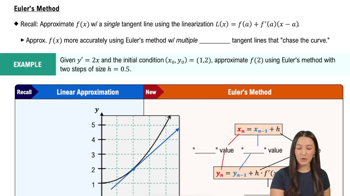
The substitution method simplifies integrals by changing variables to transform the integral into a more manageable form. It often involves setting a part of the integrand as a new variable, which helps in integrating complex expressions like those involving exponential functions.
Recommended video:
Euler's Method
Properties of Exponential Functions
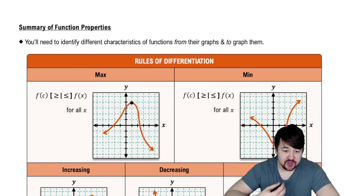
Exponential functions, such as e^x, have unique properties including their derivatives and integrals being proportional to themselves. Understanding how to manipulate expressions like e^(2x) and their relationships is crucial for simplifying and evaluating integrals involving exponentials.
Recommended video:
Properties of Functions
Related Practice
Textbook Question
Textbook Question
Evaluate the integrals in Exercises 39–56.
49. ∫3sec²t/(6 + 3tan(t)) dt
1
views
Textbook Question
In Exercises 73 and 74, repeat the steps above to solve for the functions y=f(x) and x=f^(-1)(y) defined implicitly by the given equations over the interval.
73. y^(1/3) - 1 = (x+2)³, -5 ≤ x ≤ 5, x_0 = -3/2
Textbook Question
In Exercises 21–48, find the derivative of y with respect to the appropriate variable.
39. y=arctan√(x²-1) + arccsc(x), x>1
Textbook Question
86. Use a derivative to show that g(x)=√(x² + ln x) is one-to-one.
Textbook Question
In Exercises 57–70, use logarithmic differentiation to find the derivative of y with respect to the given independent variable.
70. y = ∛(x(x+1)(x-2)/(x²+1)(2x+3))