Ch. 7 - Transcendental Functions
Hass - Thomas' Calculus 15th Edition
Hass15th EditionThomas' CalculusISBN: 9780137616077Not the one you use?Change textbook
Chapter 7, Problem 7.6.49

For problems 49–52 use implicit differentiation to find dy/dx at the given point P.
49. 3arctan(x) + arcsin(y) = π/4; P(1, -1)

Verified step by step guidance
1
Start with the given implicit equation: \(3 \arctan(x) + \arcsin(y) = \frac{\pi}{4}\).
Differentiate both sides of the equation with respect to \(x\). Remember to apply the chain rule when differentiating \(\arcsin(y)\) since \(y\) is a function of \(x\). This gives: \(3 \cdot \frac{d}{dx}[\arctan(x)] + \frac{d}{dx}[\arcsin(y)] = 0\).
Use the derivatives of the inverse trigonometric functions: \(\frac{d}{dx}[\arctan(x)] = \frac{1}{1 + x^2}\) and \(\frac{d}{dx}[\arcsin(y)] = \frac{1}{\sqrt{1 - y^2}} \cdot \frac{dy}{dx}\) by the chain rule.
Substitute these derivatives back into the differentiated equation to get: \(3 \cdot \frac{1}{1 + x^2} + \frac{1}{\sqrt{1 - y^2}} \cdot \frac{dy}{dx} = 0\).
Solve this equation for \(\frac{dy}{dx}\), then substitute the point \(P(1, -1)\) into your expression to find the slope of the tangent line at that point.

Verified video answer for a similar problem:

This video solution was recommended by our tutors as helpful for the problem above.
Video duration:
6m
Was this helpful?

Key Concepts

Here are the essential concepts you must grasp in order to answer the question correctly.

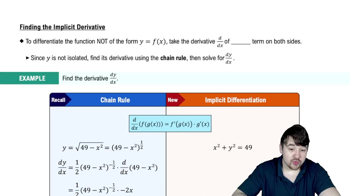
Implicit Differentiation

Implicit differentiation is a technique used to find the derivative of a function when y is defined implicitly in terms of x, rather than explicitly. It involves differentiating both sides of the equation with respect to x, treating y as a function of x, and then solving for dy/dx.
Recommended video:
05:14
Finding The Implicit Derivative

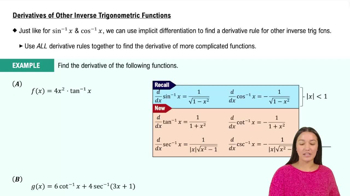
Derivatives of Inverse Trigonometric Functions

The derivatives of inverse trig functions like arctan(x) and arcsin(y) are essential for this problem. Specifically, d/dx[arctan(x)] = 1/(1+x^2) and d/dy[arcsin(y)] = 1/√(1-y^2). These formulas are used during differentiation to handle the given equation.
Recommended video:
06:35
Derivatives of Other Inverse Trigonometric Functions

Evaluating Derivatives at a Specific Point

After finding the general expression for dy/dx, substituting the coordinates of the given point P(1, -1) allows us to compute the exact slope of the curve at that point. This step ensures the derivative reflects the behavior of the function at the specified location.
Recommended video:
05:44
Derivatives