Ch. 7 - Transcendental Functions
Hass - Thomas' Calculus 15th Edition
Hass15th EditionThomas' CalculusISBN: 9780137616077Not the one you use?Change textbook
Chapter 7, Problem 7.6.99

Evaluate the integrals in Exercises 91–102.
99. ∫1/(√x (x+1)((arctan√x)²+9)) dx

Verified step by step guidance
1
Start by identifying a substitution that simplifies the integral. Notice the presence of \( \sqrt{x} \) inside the integral and in the arctan function. Let \( t = \sqrt{x} \), which implies \( x = t^2 \).
Compute the differential \( dx \) in terms of \( dt \). Since \( x = t^2 \), then \( dx = 2t \, dt \).
Rewrite the integral in terms of \( t \). Substitute \( \sqrt{x} = t \), \( x + 1 = t^2 + 1 \), and \( (\arctan \sqrt{x})^2 + 9 = (\arctan t)^2 + 9 \). Also replace \( dx \) with \( 2t \, dt \).
Simplify the integral expression after substitution. Notice that the \( \sqrt{x} = t \) in the denominator and the \( 2t \, dt \) in the numerator will allow some terms to cancel out, making the integral easier to handle.
Consider a second substitution to handle the \( (\arctan t)^2 + 9 \) term. Let \( u = \arctan t \), then \( du = \frac{1}{1 + t^2} dt \). Use this to rewrite the integral entirely in terms of \( u \) and \( du \), which should simplify the integral to a rational function in \( u \).

Verified video answer for a similar problem:

This video solution was recommended by our tutors as helpful for the problem above.
Video duration:
4m
Was this helpful?

Key Concepts

Here are the essential concepts you must grasp in order to answer the question correctly.

Integration Techniques involving Substitution

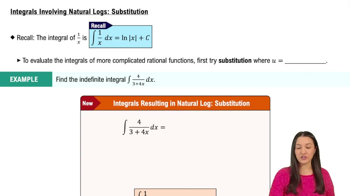
Substitution is a method used to simplify integrals by changing variables, often to transform complicated expressions into more manageable forms. In this problem, substituting u = √x can simplify the square root and arctan terms, making the integral easier to evaluate.
Recommended video:
07:01
Integrals Involving Natural Logs: Substitution

Properties and Derivatives of the Arctangent Function

Understanding the arctangent function and its derivative is crucial, as the integral contains (arctan(√x))². The derivative of arctan(u) is 1/(1+u²), which helps in recognizing patterns and applying substitution or integration by parts effectively.
Recommended video:
06:21
Properties of Functions

Integration involving Rational Functions and Composite Expressions

The integral includes a rational function with terms like 1/(√x (x+1)) and a composite function in the denominator. Recognizing how to handle products and compositions of functions, possibly through partial fractions or algebraic manipulation, is essential to simplify and solve the integral.
Recommended video:
07:01
Integrals Involving Natural Logs: Substitution