Ch. 7 - Transcendental Functions
Hass - Thomas' Calculus 15th Edition
Hass15th EditionThomas' CalculusISBN: 9780137616077Not the one you use?Change textbook
Chapter 7, Problem 7.3.99

Evaluate the integrals in Exercises 97–110.
99. ∫₀³ (√2 + 1)x^(√2) dx

Verified step by step guidance
1
Identify the integral to be evaluated: \(\int_0^3 (\sqrt{2} + 1) x^{\sqrt{2}} \, dx\).
Since \((\sqrt{2} + 1)\) is a constant coefficient, factor it out of the integral: \( (\sqrt{2} + 1) \int_0^3 x^{\sqrt{2}} \, dx\).
Recall the power rule for integration: \(\int x^n \, dx = \frac{x^{n+1}}{n+1} + C\), where \(n \neq -1\).
Apply the power rule to \(\int_0^3 x^{\sqrt{2}} \, dx\), which becomes \(\left[ \frac{x^{\sqrt{2} + 1}}{\sqrt{2} + 1} \right]_0^3\).
Multiply the result by the constant \((\sqrt{2} + 1)\) and then evaluate the expression at the upper limit \(x=3\) and lower limit \(x=0\), subtracting the two values to find the definite integral.

Verified video answer for a similar problem:

This video solution was recommended by our tutors as helpful for the problem above.
Video duration:
2m
Was this helpful?

Key Concepts

Here are the essential concepts you must grasp in order to answer the question correctly.

Definite Integrals

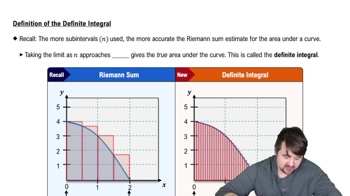
A definite integral calculates the net area under a curve between two specified limits. It is represented as ∫_a^b f(x) dx, where a and b are the lower and upper bounds. Evaluating a definite integral involves finding the antiderivative and then applying the Fundamental Theorem of Calculus.
Recommended video:
05:43
Definition of the Definite Integral

Power Rule for Integration

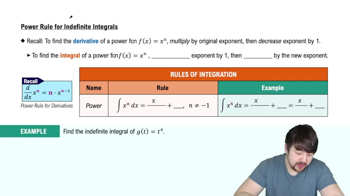
The power rule states that ∫ x^n dx = (x^(n+1)) / (n+1) + C for any real number n ≠ -1. This rule is essential for integrating functions where the variable is raised to a constant power, including irrational exponents like √2.
Recommended video:
04:04
Power Rule for Indefinite Integrals

Constant Multiples in Integration

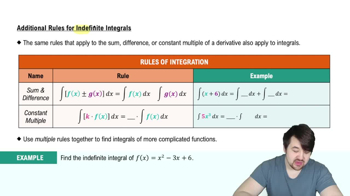
When integrating, constants can be factored out of the integral to simplify calculations. For example, ∫ c·f(x) dx = c ∫ f(x) dx, where c is a constant. This allows the integral of (√2 + 1) x^(√2) to be treated as (√2 + 1) times the integral of x^(√2).
Recommended video:
05:56
Additional Rules for Indefinite Integrals