Ch. 7 - Transcendental Functions
Hass - Thomas' Calculus 15th Edition
Hass15th EditionThomas' CalculusISBN: 9780137616077Not the one you use?Change textbook
Chapter 7, Problem 7.2.82

82. Find a curve through the point (1, 0) whose length from x=1 to x=2 is
L = ∫(from 1 to 2)√(1 + 1/x²)dx.

Verified step by step guidance
1
Recognize that the problem asks for a curve \( y = f(x) \) passing through the point \( (1, 0) \) such that the length of the curve from \( x=1 \) to \( x=2 \) is given by the integral \( L = \int_1^2 \sqrt{1 + \frac{1}{x^2}} \, dx \). This integral represents the arc length formula \( L = \int_a^b \sqrt{1 + (y')^2} \, dx \).
From the arc length formula, identify that \( \sqrt{1 + (y')^2} = \sqrt{1 + \frac{1}{x^2}} \). Equate the expressions inside the square roots to find \( (y')^2 = \frac{1}{x^2} \).
Solve for \( y' \) by taking the square root of both sides, giving \( y' = \pm \frac{1}{x} \). This is a separable differential equation.
Integrate both sides with respect to \( x \): \( dy = \pm \frac{1}{x} dx \) leads to \( y = \pm \ln|x| + C \), where \( C \) is the constant of integration.
Use the initial condition \( y(1) = 0 \) to find \( C \). Substitute \( x=1 \) and \( y=0 \) into the equation to solve for \( C \), which will give the specific curve satisfying the problem.

Verified video answer for a similar problem:

This video solution was recommended by our tutors as helpful for the problem above.
Video duration:
3m
Was this helpful?

Key Concepts

Here are the essential concepts you must grasp in order to answer the question correctly.

Arc Length Formula

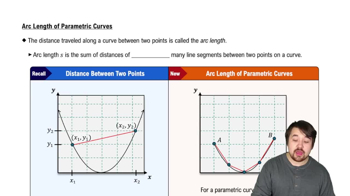
The arc length of a curve y = f(x) from x = a to x = b is given by the integral L = ∫ from a to b √(1 + (dy/dx)²) dx. This formula calculates the length of the curve by summing infinitesimal line segments along the curve.
Recommended video:
06:29
Arc Length of Parametric Curves

Differential Equation from Arc Length Integrand

Given the integrand √(1 + (dy/dx)²) = √(1 + 1/x²), we can equate (dy/dx)² = 1/x², leading to a differential equation dy/dx = ±1/x. Solving this differential equation helps find the explicit form of the curve.
Recommended video:
06:29
Arc Length of Parametric Curves

Initial Condition and Integration

Using the initial point (1, 0), we integrate dy/dx = 1/x to find y = ln|x| + C. Applying the initial condition y(1) = 0 determines the constant C, yielding the specific curve that satisfies the given length integral.
Recommended video:
05:03
Initial Value Problems