Ch. 7 - Transcendental Functions
Hass - Thomas' Calculus 15th Edition
Hass15th EditionThomas' CalculusISBN: 9780137616077Not the one you use?Change textbook
Chapter 7, Problem 7.3.89

Evaluate the integrals in Exercises 87–96.
89. ∫₀¹ 2^(−θ) dθ

Verified step by step guidance
1
Identify the integral to be evaluated: \(\int_0^1 2^{-\theta} \, d\theta\).
Rewrite the integrand using the exponential function with base \(e\): \(2^{-\theta} = e^{-\theta \ln(2)}\).
Set up the integral with the exponential form: \(\int_0^1 e^{-\theta \ln(2)} \, d\theta\).
Integrate using the formula for the integral of an exponential function: \(\int e^{ax} \, dx = \frac{1}{a} e^{ax} + C\). Here, \(a = -\ln(2)\).
Evaluate the definite integral by substituting the limits \(\theta = 0\) and \(\theta = 1\) into the antiderivative and subtracting: \(\left[ \frac{e^{-\theta \ln(2)}}{-\ln(2)} \right]_0^1\).

Verified video answer for a similar problem:

This video solution was recommended by our tutors as helpful for the problem above.
Video duration:
3m
Was this helpful?

Key Concepts

Here are the essential concepts you must grasp in order to answer the question correctly.

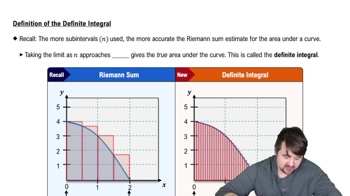
Definite Integral

A definite integral calculates the net area under a curve between two limits. It is represented as ∫_a^b f(x) dx, where a and b are the bounds. Evaluating a definite integral involves finding the antiderivative and then applying the Fundamental Theorem of Calculus.
Recommended video:
05:43
Definition of the Definite Integral

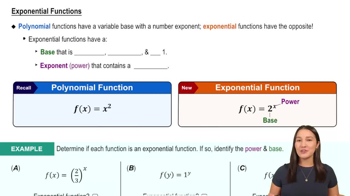
Exponential Functions with Variable Exponents

Exponential functions like 2^(-θ) have a constant base and a variable exponent. Understanding how to integrate such functions requires rewriting them using natural logarithms or recognizing their derivative patterns, as the integral of a^x involves dividing by ln(a).
Recommended video:
6:13
Exponential Functions

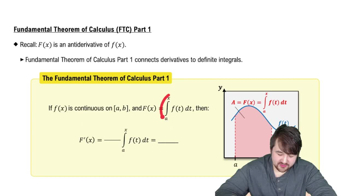
Fundamental Theorem of Calculus

This theorem links differentiation and integration, stating that if F is an antiderivative of f, then ∫_a^b f(x) dx = F(b) - F(a). It allows evaluation of definite integrals by computing the difference of antiderivative values at the bounds.
Recommended video:
06:11
Fundamental Theorem of Calculus Part 1