Ch. 7 - Transcendental Functions
Hass - Thomas' Calculus 15th Edition
Hass15th EditionThomas' CalculusISBN: 9780137616077Not the one you use?Change textbook
Chapter 7, Problem 7.1.19

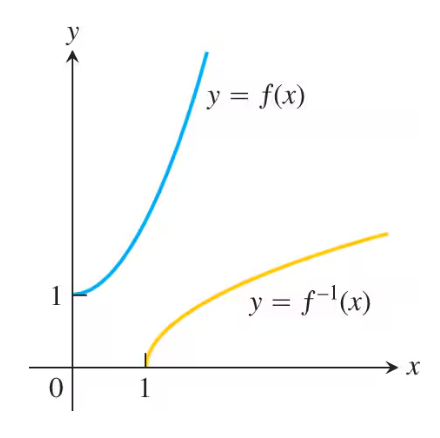
Each of Exercises 19–24 gives a formula for a function y=f(x) and shows the graphs of f and f^(-1). Find a formula for f^(-1) in each case.
f(x)=x²+1, x≥0
Graph showing function y = x² + 1 (x≥0) and its inverse y = √(x - 1) with labeled axes.

Verified step by step guidance
1
Start with the given function: \(y = f(x) = x^{2} + 1\) where \(x \geq 0\).
To find the inverse function \(f^{-1}(x)\), first replace \(f(x)\) with \(y\): \(y = x^{2} + 1\).
Swap the variables \(x\) and \(y\) to find the inverse: \(x = y^{2} + 1\).
Solve this equation for \(y\): subtract 1 from both sides to get \(x - 1 = y^{2}\).
Since \(x \geq 0\) in the original function, take the positive square root to get \(y = \sqrt{x - 1}\), which is the formula for \(f^{-1}(x)\).

Verified video answer for a similar problem:

This video solution was recommended by our tutors as helpful for the problem above.
Video duration:
3m
Was this helpful?

Key Concepts

Here are the essential concepts you must grasp in order to answer the question correctly.

Inverse Functions

An inverse function reverses the effect of the original function, swapping inputs and outputs. If y = f(x), then x = f⁻¹(y). The graph of an inverse function is a reflection of the original function's graph across the line y = x.
Recommended video:
4:49
Inverse Cosine

Domain and Range Restrictions

To find an inverse function, the original function must be one-to-one, often requiring domain restrictions. Here, f(x) = x² + 1 is restricted to x ≥ 0 to ensure it is invertible, as the parabola is not one-to-one over all real numbers.
Recommended video:
5:10
Finding the Domain and Range of a Graph

Finding the Inverse Function Algebraically

To find f⁻¹(x), replace f(x) with y, swap x and y, then solve for y. For f(x) = x² + 1 with x ≥ 0, swapping gives x = y² + 1, so y = √(x - 1), which matches the inverse function shown in the graph.
Recommended video:
4:49
Inverse Cosine