Ch. 7 - Transcendental Functions
Hass - Thomas' Calculus 15th Edition
Hass15th EditionThomas' CalculusISBN: 9780137616077Not the one you use?Change textbook
Chapter 7, Problem 7.5.86c

86. This exercise explores the difference between
lim(x→∞)(1 + 1/x²)^x
and
lim(x→∞)(1 + 1/x)^x = e
c. Confirm your estimate of lim(x→∞)f(x) by calculating it with l’Hôpital’s Rule.

Verified step by step guidance
1
First, identify the function whose limit we want to find: \(f(x) = \left(1 + \frac{1}{x^{2}}\right)^{x}\). We want to evaluate \(\lim_{x \to \infty} f(x)\).
Rewrite the expression using the natural logarithm to handle the exponent more easily: consider \(\ln(f(x)) = x \cdot \ln\left(1 + \frac{1}{x^{2}}\right)\).
Set \(y = \ln(f(x)) = x \cdot \ln\left(1 + \frac{1}{x^{2}}\right)\). To find \(\lim_{x \to \infty} f(x)\), we first find \(\lim_{x \to \infty} y\) and then exponentiate the result.
Rewrite \(y\) as a quotient to apply l’Hôpital’s Rule: \(y = \frac{\ln\left(1 + \frac{1}{x^{2}}\right)}{\frac{1}{x}}\). As \(x \to \infty\), both numerator and denominator approach 0, so l’Hôpital’s Rule applies.
Differentiate numerator and denominator with respect to \(x\): - Numerator derivative: \(\frac{d}{dx} \ln\left(1 + \frac{1}{x^{2}}\right) = \frac{1}{1 + \frac{1}{x^{2}}} \cdot \left(-\frac{2}{x^{3}}\right)\), - Denominator derivative: \(\frac{d}{dx} \left(\frac{1}{x}\right) = -\frac{1}{x^{2}}\). Then, compute the limit of the ratio of these derivatives as \(x \to \infty\) to find \(\lim_{x \to \infty} y\).

Verified video answer for a similar problem:

This video solution was recommended by our tutors as helpful for the problem above.
Video duration:
4m
Was this helpful?

Key Concepts

Here are the essential concepts you must grasp in order to answer the question correctly.

Limits at Infinity

Limits at infinity describe the behavior of a function as the input grows without bound. Understanding how expressions like (1 + 1/x)^x behave as x approaches infinity is crucial for evaluating these limits and recognizing patterns that lead to constants such as e.
Recommended video:
03:07
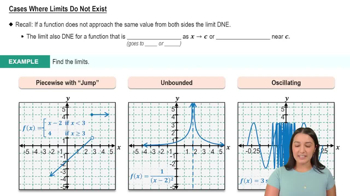
Cases Where Limits Do Not Exist

The Number e and Exponential Limits

The number e is defined as the limit of (1 + 1/x)^x as x approaches infinity. This fundamental constant arises naturally in calculus and exponential growth problems. Recognizing variations of this limit helps in comparing and estimating similar expressions.
Recommended video:
4:47
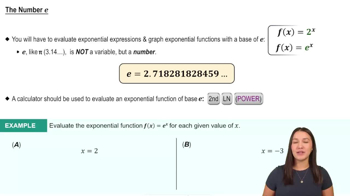
The Number e

l’Hôpital’s Rule

l’Hôpital’s Rule is a method for evaluating indeterminate forms like 0/0 or ∞/∞ by differentiating the numerator and denominator separately. It is especially useful for confirming limits that are difficult to evaluate directly, such as those involving complex expressions raised to powers.
Recommended video: