
Textbook Question
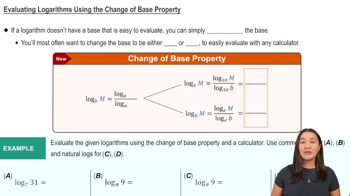
2. Express the following logarithms in terms of ln 5 and ln 7.
d. ln 1225

 Verified step by step guidance
 05:36
05:36
 05:18
05:18 04:21
04:212. Express the following logarithms in terms of ln 5 and ln 7.
d. ln 1225
In Exercises 67–72, you will explore some functions and their inverses together with their derivatives and tangent line approximations at specified points. Perform the following steps using your CAS:
d. Find the equation for the tangent line to g at the point (f(x_0), x_0) located symmetrically across the 45° line y=x (which is the graph of the identity function). Use Theorem 1 to find the slope of this tangent line.
68. y= (3x+2)/(2x-11), -2 ≤ x ≤ 2, x_0=1/2
In Exercises 67–72, you will explore some functions and their inverses together with their derivatives and tangent line approximations at specified points. Perform the following steps using your CAS:
d. Find the equation for the tangent line to g at the point (f(x_0), x_0) located symmetrically across the 45° line y=x (which is the graph of the identity function). Use Theorem 1 to find the slope of this tangent line.
67. y= √(3x-2), 2/3 ≤ x ≤ 4, x_0=3
In Exercises 67–72, you will explore some functions and their inverses together with their derivatives and tangent line approximations at specified points. Perform the following steps using your CAS:
d. Find the equation for the tangent line to g at the point (f(x_0), x_0) located symmetrically across the 45° line y=x (which is the graph of the identity function). Use Theorem 1 to find the slope of this tangent line.
70. y= x³/(x²+1), -1 ≤ x ≤ 1, x_0=1/2
3. Which of the following functions grow faster than x² as x→∞? Which grow at the same rate as x²? Which grow slower?
e. x ln(x)
In Exercises 67–72, you will explore some functions and their inverses together with their derivatives and tangent line approximations at specified points. Perform the following steps using your CAS:
d. Find the equation for the tangent line to g at the point (f(x_0), x_0) located symmetrically across the 45° line y=x (which is the graph of the identity function). Use Theorem 1 to find the slope of this tangent line.
72. y= 2-x-x³, -2 ≤ x ≤ 2, x_0 = 3/2