Ch. 7 - Transcendental Functions
Hass - Thomas' Calculus 15th Edition
Hass15th EditionThomas' CalculusISBN: 9780137616077Not the one you use?Change textbook
Chapter 7, Problem 7.2.4c

4. Use the properties of logarithms to write the expressions in Exercises 3 and 4 as a single term.
c. 3ln ∛(t² - 1) - ln(t+1)

Verified step by step guidance
1
Identify the properties of logarithms that will help combine the terms: the power rule \(a \ln b = \ln b^a\) and the subtraction rule \(\ln A - \ln B = \ln \left( \frac{A}{B} \right)\).
Apply the power rule to the first term: rewrite \(3 \ln \sqrt[3]{t^2 - 1}\) as \(\ln \left( \sqrt[3]{t^2 - 1} \right)^3\).
Simplify the expression inside the logarithm by raising the cube root to the third power: \(\left( \sqrt[3]{t^2 - 1} \right)^3 = t^2 - 1\).
Rewrite the expression now as \(\ln (t^2 - 1) - \ln (t + 1)\).
Use the subtraction rule to combine the logarithms into a single term: \(\ln \left( \frac{t^2 - 1}{t + 1} \right)\).

Verified video answer for a similar problem:

This video solution was recommended by our tutors as helpful for the problem above.
Video duration:
2m
Was this helpful?

Key Concepts

Here are the essential concepts you must grasp in order to answer the question correctly.

Properties of Logarithms

Logarithmic properties include rules such as the product, quotient, and power rules. These allow combining or breaking down logarithmic expressions, for example, ln(a) + ln(b) = ln(ab), ln(a) - ln(b) = ln(a/b), and k·ln(a) = ln(a^k). Understanding these is essential to rewrite expressions as a single logarithm.
Recommended video:
05:36
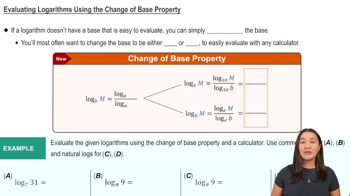
Change of Base Property

Exponent and Root Relationships

Roots can be expressed as fractional exponents, such as the cube root of x being x^(1/3). This allows rewriting expressions inside logarithms with roots into powers, facilitating the use of logarithm power rules to simplify or combine terms.
Recommended video:
Guided course
7:39
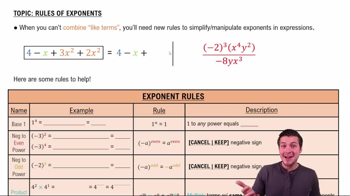
Introduction to Exponent Rules

Combining Logarithmic Expressions

To write multiple logarithmic terms as a single term, apply the properties of logarithms step-by-step: first convert coefficients to exponents, then use product or quotient rules to combine terms. This process simplifies complex expressions into one logarithm.
Recommended video:
7:30
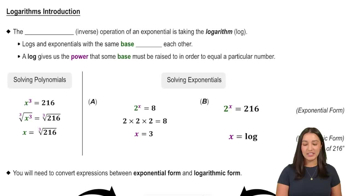
Logarithms Introduction