Ch. 5 - Integrals
Hass - Thomas' Calculus 15th Edition
Hass15th EditionThomas' CalculusISBN: 9780137616077Not the one you use?Change textbook
Chapter 5, Problem 5.PE.7

Definite Integrals


In Exercises 5–8, express each limit as a definite integral. Then evaluate the integral to find the value of the limit. In each case, P is a partition of the given interval, and the numbers cₖ are chosen from the subintervals of P.


     n
 lim  ∑ (cos(cₖ/2)) ∆xₖ, where P is a partition of [-π, 0]
 ∥P∥→0  k = 1

Verified step by step guidance
1
Recognize that the given limit of the sum is a Riemann sum representing a definite integral over the interval \([-\pi, 0]\). The sum is of the form \(\sum_{k=1}^n f(c_k) \Delta x_k\), where \(f(x) = \cos\left(\frac{x}{2}\right)\).
Identify the interval of integration from the partition \(P\), which is \([-\pi, 0]\). The limit as \(\|P\| \to 0\) means the norm of the partition approaches zero, ensuring the sum approaches the integral.
Express the limit as the definite integral: \[\lim_{\|P\| \to 0} \sum_{k=1}^n \cos\left(\frac{c_k}{2}\right) \Delta x_k = \int_{-\pi}^0 \cos\left(\frac{x}{2}\right) \, dx\]
To evaluate the integral, use a substitution method. Let \(u = \frac{x}{2}\), so that \(dx = 2 \, du\). Adjust the limits of integration accordingly: when \(x = -\pi\), \(u = -\frac{\pi}{2}\); when \(x = 0\), \(u = 0\).
Rewrite the integral in terms of \(u\) and integrate: \[\int_{-\frac{\pi}{2}}^0 \cos(u) \cdot 2 \, du = 2 \int_{-\frac{\pi}{2}}^0 \cos(u) \, du\] Then compute the integral of \(\cos(u)\) over the new limits.

Verified video answer for a similar problem:

This video solution was recommended by our tutors as helpful for the problem above.
Video duration:
7m
Was this helpful?

Key Concepts

Here are the essential concepts you must grasp in order to answer the question correctly.

Definite Integral as a Limit of Riemann Sums

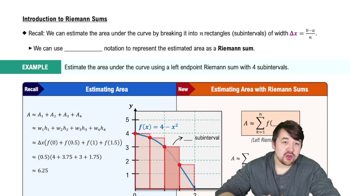
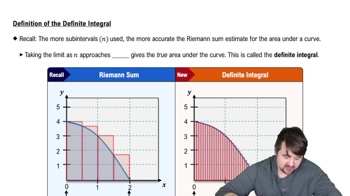
A definite integral can be defined as the limit of Riemann sums, where the sum of function values at chosen points multiplied by subinterval widths approaches the integral as the partition gets finer. This concept connects sums to integrals and is fundamental for interpreting limits of sums as integrals.
Recommended video:
06:11
Introduction to Riemann Sums

Partition and Norm of a Partition

A partition divides an interval into subintervals, and the norm of a partition is the length of the largest subinterval. As the norm approaches zero, the partition becomes finer, ensuring the Riemann sum better approximates the integral. Understanding this helps in recognizing the limit process in definite integrals.

Evaluating Definite Integrals of Trigonometric Functions

Evaluating definite integrals involving trigonometric functions requires knowledge of antiderivatives and properties of trig functions. For example, integrating cos(x/2) involves substitution to handle the inner function, and applying limits yields the exact value of the integral over the given interval.
Recommended video:
05:43
Definition of the Definite Integral