Ch. 5 - Integrals
Hass - Thomas' Calculus 15th Edition
Hass15th EditionThomas' CalculusISBN: 9780137616077Not the one you use?Change textbook
Chapter 5, Problem 5.PE.77

In Exercises 75–78, find dy/dx.
y = ∫(from x to 1) (6/(3 + t^4))dt

Verified step by step guidance
1
Recognize that the function y is defined as a definite integral with a variable limit: \(y = \int_{x}^{1} \frac{6}{3 + t^{4}} \, dt\).
Recall the Leibniz rule for differentiation of an integral with variable limits: if \(y = \int_{a(x)}^{b(x)} f(t) \, dt\), then \(\frac{dy}{dx} = f(b(x)) \cdot b'(x) - f(a(x)) \cdot a'(x)\).
Identify the limits of integration: the lower limit is \(x\) and the upper limit is the constant \(1\). Therefore, \(a(x) = x\) and \(b(x) = 1\).
Calculate the derivatives of the limits: \(a'(x) = \frac{d}{dx} x = 1\) and \(b'(x) = \frac{d}{dx} 1 = 0\).
Apply the Leibniz rule: \(\frac{dy}{dx} = f(1) \cdot 0 - f(x) \cdot 1 = - \frac{6}{3 + x^{4}}\).

Verified video answer for a similar problem:

This video solution was recommended by our tutors as helpful for the problem above.
Video duration:
2m
Was this helpful?

Key Concepts

Here are the essential concepts you must grasp in order to answer the question correctly.

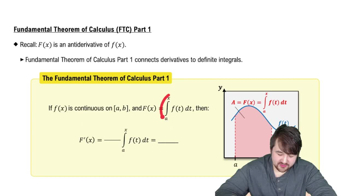
Fundamental Theorem of Calculus Part 1

This theorem connects differentiation and integration, stating that if a function is defined as an integral with a variable limit, its derivative is the integrand evaluated at that limit, multiplied by the derivative of the limit. It allows us to differentiate integrals with variable limits directly.
Recommended video:
06:11
Fundamental Theorem of Calculus Part 1

Leibniz Rule for Differentiation under the Integral Sign

Leibniz Rule generalizes differentiation of integrals with variable limits. When both limits depend on x, the derivative of the integral is the integrand evaluated at the upper limit times the derivative of the upper limit minus the integrand at the lower limit times the derivative of the lower limit.
Recommended video:
05:56
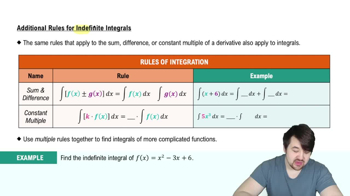
Additional Rules for Indefinite Integrals

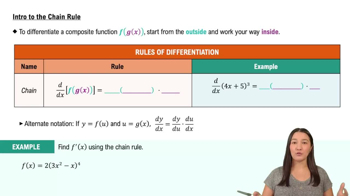
Chain Rule

The chain rule is used to differentiate composite functions. When the limits of integration are functions of x, the derivative of the integral involves multiplying the integrand evaluated at the limit by the derivative of that limit, applying the chain rule to handle the inner function.
Recommended video:
05:02
Intro to the Chain Rule