Ch. 5 - Integrals
Hass - Thomas' Calculus 15th Edition
Hass15th EditionThomas' CalculusISBN: 9780137616077Not the one you use?Change textbook
Chapter 5, Problem 5.PE.10b

If ∫₀² ƒ(x) dx = π, ∫₀² 7g(x) dx = 7, and ∫₀¹ g(x) dx = 2, find the value of each of the following.


b. ∫₁² g(x) dx

Verified step by step guidance
1
Recall the property of definite integrals that allows us to split an integral over an interval into the sum of integrals over subintervals: \(\int_a^c f(x) \, dx = \int_a^b f(x) \, dx + \int_b^c f(x) \, dx\) for any \(a < b < c\).
Apply this property to the integral \(\int_0^2 g(x) \, dx\), splitting it at \(x=1\): \(\int_0^2 g(x) \, dx = \int_0^1 g(x) \, dx + \int_1^2 g(x) \, dx\).
We are given \(\int_0^1 g(x) \, dx = 2\), so substitute this value into the equation: \(\int_0^2 g(x) \, dx = 2 + \int_1^2 g(x) \, dx\).
Next, use the information about \(\int_0^2 7g(x) \, dx = 7\). Since the integral of a constant times a function is the constant times the integral of the function, write \(7 \int_0^2 g(x) \, dx = 7\).
Divide both sides by 7 to find \(\int_0^2 g(x) \, dx = 1\). Substitute this back into the equation from step 3 to solve for \(\int_1^2 g(x) \, dx\): \(1 = 2 + \int_1^2 g(x) \, dx\), then isolate \(\int_1^2 g(x) \, dx\).

Verified video answer for a similar problem:

This video solution was recommended by our tutors as helpful for the problem above.
Video duration:
3m
Was this helpful?

Key Concepts

Here are the essential concepts you must grasp in order to answer the question correctly.

Definite Integral and Area Interpretation

A definite integral ∫_a^b f(x) dx represents the net area under the curve f(x) from x = a to x = b. It accumulates the values of the function over the interval, which can be used to find total quantities or changes between two points.
Recommended video:
05:43
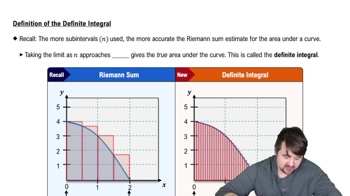
Definition of the Definite Integral

Linearity of the Integral

The integral operator is linear, meaning ∫_a^b [c·f(x)] dx = c·∫_a^b f(x) dx for any constant c. This property allows us to factor constants out of integrals and simplify expressions involving scaled functions.
Recommended video:
07:17
Linearization

Additivity of Integrals over Adjacent Intervals

The integral over an interval can be split into sums over subintervals: ∫_a^c f(x) dx = ∫_a^b f(x) dx + ∫_b^c f(x) dx for a < b < c. This helps find unknown integrals by subtracting known parts from the whole.
Recommended video:
05:56
Additional Rules for Indefinite Integrals