Back
Back
Problem 4.3.44a
Identifying Extrema
In Exercises 41–52:
a. Identify the function’s local extreme values in the given domain, and say where they occur.
g(x) = −x² − 6x − 9,−4 ≤ x < ∞
Problem 4.3.48a
Identifying Extrema
In Exercises 41–52:
a. Identify the function’s local extreme values in the given domain, and say where they occur.
k(x) = x³ + 3x² + 3x + 1, −∞ < x ≤ 0
Problem 4.3.5a
Analyzing Functions from Derivatives
Answer the following questions about the functions whose derivatives are given in Exercises 1–14:
a. What are the critical points of f?
f′(x) = (x − 1)(x + 2)(x − 3)
Problem 4.3.43a
Identifying Extrema
In Exercises 41–52:
a. Identify the function’s local extreme values in the given domain, and say where they occur.
g(x) = x² − 4x + 4, 1 ≤ x < ∞
Problem 4.3.50a
Identifying Extrema
In Exercises 41–52:
a. Identify the function’s local extreme values in the given domain, and say where they occur.
f(x) = √(x² − 2x − 3), 3 ≤ x < ∞
Problem 4.3.59a
Identifying Extrema
In Exercises 53–60:
a. Find the local extrema of each function on the given interval, and say where they occur.
f(x) = csc²x − 2cot x, 0 < x < π
Problem 4.3.45a
Identifying Extrema
In Exercises 41–52:
a. Identify the function’s local extreme values in the given domain, and say where they occur.
f(t) = 12t − t³, −3 ≤ t < ∞
Problem 4.7.15a
Finding Antiderivatives
In Exercises 1–16, find an antiderivative for each function. Do as many as you can mentally. Check your answers by differentiation.
csc x cot x
Problem 4.7.9a
Finding Antiderivatives
In Exercises 1–16, find an antiderivative for each function. Do as many as you can mentally. Check your answers by differentiation.
(2/3)x⁻¹ᐟ³
Problem 4.5.53a
53. Distance between two ships At noon, ship A was 12 nautical miles due north of ship B. Ship A was sailing south at 12 knots (nautical miles per hour; a nautical mile is 2000 yd) and continued to do so all day. Ship B was sailing east at 8 knots and continued to do so all day.
a. Start counting time with t=0 at noon and express the distance s between the ships as a function of t.
Problem 4.3.68a
Theory and Examples
Sketch the graph of a differentiable function y = f(x) that has a local minimum at (1, 1) and a local maximum at (3, 3).
Problem 4.3.54a
Identifying Extrema
In Exercises 53–60:
a. Find the local extrema of each function on the given interval, and say where they occur.
f(x) = sin x − cos x,0 ≤ x ≤ 2π
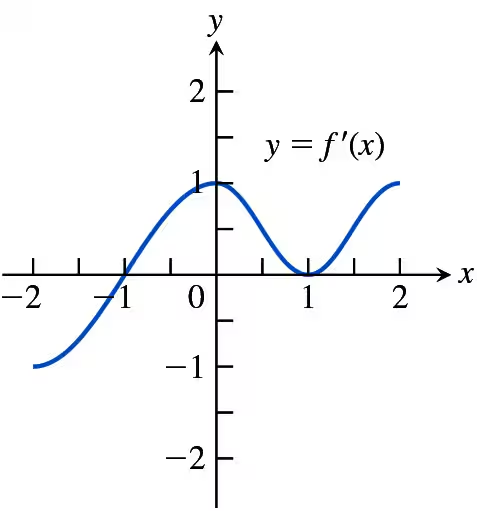
Problem 4.3.63a
Identifying Extrema
In Exercises 63 and 64, the graph of f' is given. Assume that f has domain (-2, 2).
a. Either use the graph to determine which intervals f is increasing on and which intervals f is decreasing on, or explain why this information cannot be determined from the graph.
Problem 4.7.101a
Finding displacement from an antiderivative of velocity
a. Suppose that the velocity of a body moving along the s-axis is
ds/dt = v = 9.8t − 3.
i. Find the body’s displacement over the time interval from t = 1 to t = 3 given that s = 5 when t = 0.
Problem 4.2.15ai
Roots (Zeros)
a. Plot the zeros of each polynomial on a line together with the zeros of its first derivative.
i. y = x² − 4
Problem 4.2.15aiii
Roots (Zeros)
a. Plot the zeros of each polynomial on a line together with the zeros of its first derivative.
iii. y = x³ − 3x² + 4 = (x + 1)(x − 2)²
Problem 4.2.15aiv
Roots (Zeros)
a. Plot the zeros of each polynomial on a line together with the zeros of its first derivative.
iv. y = x³ − 33x² + 216x = x(x - 9)(x − 24)
Problem 4.1.51b
Theory and Examples
In Exercises 51 and 52, give reasons for your answers.
Let f(x) = (x − 2)²ᐟ³.
b. Show that the only local extreme value of f occurs at x = 2.
Problem 4.7.65b
Checking Antiderivative Formulas
Right, or wrong? Say which for each formula and give a brief reason for each answer.
∫3(2x + 1)² dx = (2x + 1)³ + C
Problem 4.7.8b
Finding Antiderivatives
In Exercises 1–16, find an antiderivative for each function. Do as many as you can mentally. Check your answers by differentiation.
1/(3³√x)
Problem 4.7.63b
Checking Antiderivative Formulas
Right, or wrong? Say which for each formula and give a brief reason for each answer.
∫xsinx dx = -x cos x + C
Problem 4.5.17b
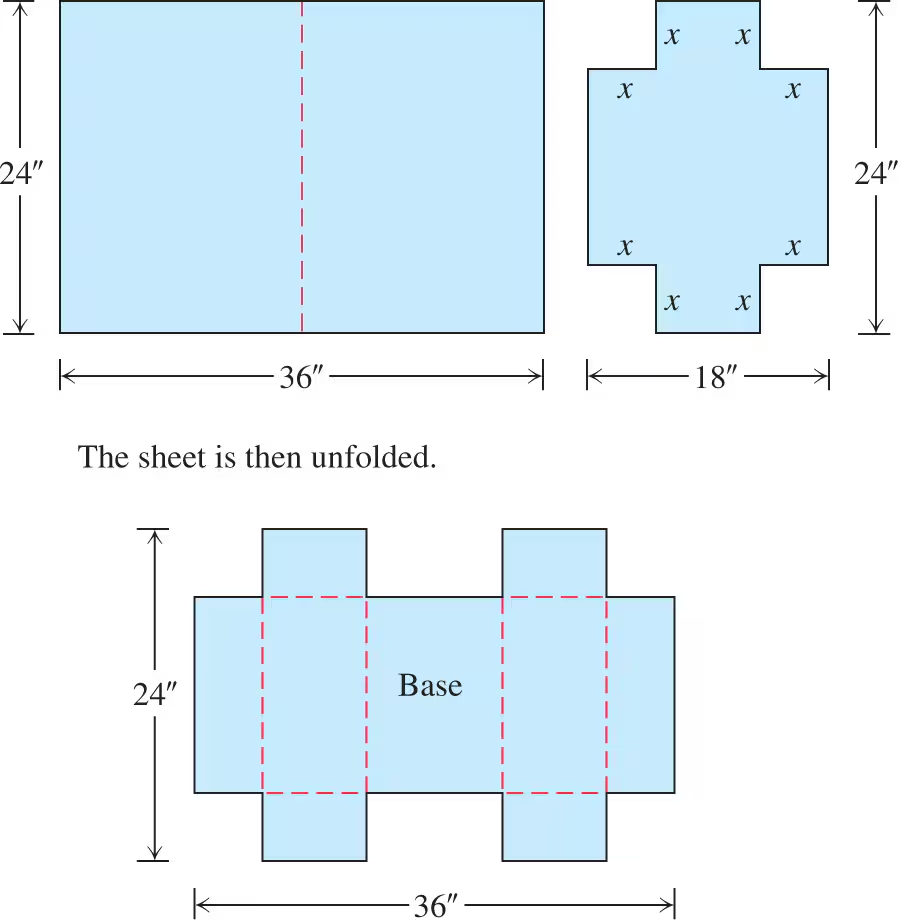
[Technology Exercise] 17. Designing a suitcase A 24-in.-by-36-in. sheet of cardboard is folded in half to form a 24-in.-by-18-in. rectangle as shown in the accompanying figure. Then four congruent squares of side length x are cut from the corners of the folded rectangle. The sheet is unfolded, and the six tabs are folded up to form a box with sides and a lid.
b. Find the domain of V for the problem situation and graph V over this domain.
Problem 4.4.114b
114. Parabolas
b. When is the parabola concave up? Concave down?
Problem 4.3.25b
Identifying Extrema
In Exercises 19–40:
b. Identify the function’s local extreme values, if any, saying where they occur.
f(r) = 3r³ + 16r
Problem 4.3.1b
Analyzing Functions from Derivatives
Answer the following questions about the functions whose derivatives are given in Exercises 1–14:
b. On what open intervals is f increasing or decreasing?
f′(x) = x(x − 1)
Problem 4.5.16b
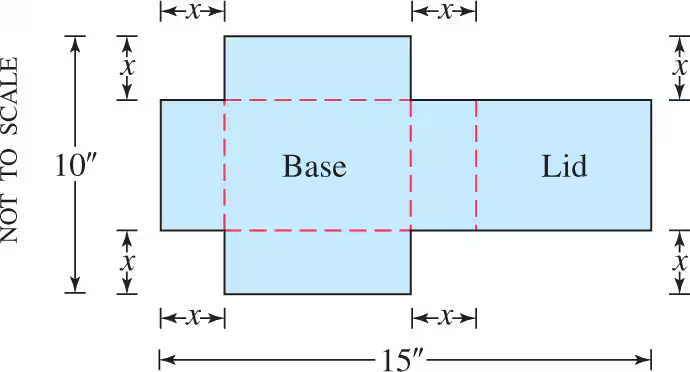
[Technology Exercise] 16. Designing a box with a lid A piece of cardboard measures 10 in. by 15 in. Two equal squares are removed from the corners of a 10-in. side as shown in the figure. Two equal rectangles are removed from the other corners so that the tabs can be folded to form a rectangular box with lid.
b. Find the domain of V for the problem situation and graph V over this domain.
Problem 4.3.23b
Identifying Extrema
In Exercises 19–40:
b. Identify the function’s local extreme values, if any, saying where they occur.
f(θ) = 3θ² − 4θ³
Problem 4.5.38b
38. What values of a and b make f(x) = x^3 + ax^2 + bx have
b. a local minimum at x = 4 and a point of inflection at x = 1?
Problem 4.7.16b
Finding Antiderivatives
In Exercises 1–16, find an antiderivative for each function. Do as many as you can mentally. Check your answers by differentiation.
4 sec 3x tan 3x
Problem 4.1.52b
Theory and Examples
In Exercises 51 and 52, give reasons for your answers.
Let f(x) = |x³ − 9x|.
b. Does f'(3) exist?