Back
Back
Problem 4.3.37
Identifying Extrema
In Exercises 19–40:
a. Find the open intervals on which the function is increasing and those on which it is decreasing.
b. Identify the function’s local extreme values, if any, saying where they occur.
f(x) = x¹ᐟ³(x + 8)
Problem 4.3.33
Identifying Extrema
In Exercises 19–40:
a. Find the open intervals on which the function is increasing and those on which it is decreasing.
b. Identify the function’s local extreme values, if any, saying where they occur.
g(x) = x√8 − x²
Problem 4.5.6
6. You are planning to close off a corner of the first quadrant with a line segment 20 units long running from (a, 0) to (0,b). Show that the area of the triangle enclosed by the segment is largest when a = b.
Problem 4.7.87
Initial Value Problems
Solve the initial value problems in Exercises 71–90.
d³y/dx³ = 6; y″(0) = −8, y′(0) = 0, y(0) = 5
Problem 4.4.27
In Exercises 9–66, graph the function using appropriate methods from the graphing procedures presented just before Example 9, identifying the coordinates of any local extreme points and inflection points. Then find coordinates of absolute extreme points, if any.
y = 1 / (x² - 1)
Problem 4.5.42
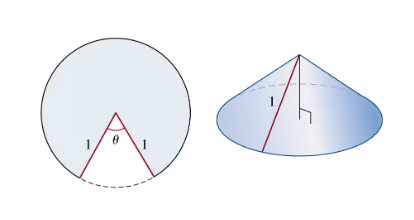
A cone is formed from a circular piece of material of radius 1 meter by removing a section of angle θ and then joining the two straight edges. Determine the largest possible volume for the cone.
Problem 4.3.31
Identifying Extrema
In Exercises 19–40:
a. Find the open intervals on which the function is increasing and those on which it is decreasing.
b. Identify the function’s local extreme values, if any, saying where they occur.
f(x) = x − 6√(x − 1)
Problem 4.5.37
37. What value of a makes f(x) = x^2 +(a/x) have
a. a local minimum at x = 2?
b. a point of inflection at x = 1?
Problem 4.1.45
Finding Critical Points
In Exercises 41–50, determine all critical points and all domain endpoints for each function.
y = x² + 2/x
Problem 4.7.75
Initial Value Problems
Solve the initial value problems in Exercises 71–90.
dy/dx = 3x⁻²ᐟ³, y(−1) = −5
Problem 4.4.107
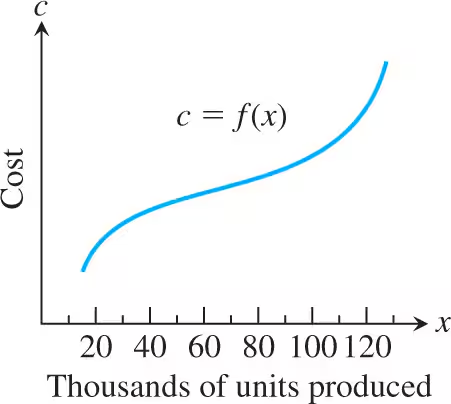
107. Marginal cost The accompanying graph shows the hypothetical cost c=f(x) of manufacturing x items. At approximately what production level does the marginal cost change from decreasing to increasing?
Problem 4.7.56
Finding Indefinite Integrals
In Exercises 17–56, find the most general antiderivative or indefinite integral. You may need to try a solution and then adjust your guess. Check your answers by differentiation.
∫csc θ/(csc θ − sin θ) dθ
Problem 4.2.37
Finding Functions from Derivatives
In Exercises 37–40, find the function with the given derivative whose graph passes through the point P.
f'(x) = 2x − 1, P(0,0)
Problem 4.14
Find values of a and b such that the function
ƒ(𝓍) = (a𝓍 + b) / 𝓍² ―1)
has a local extreme value of 1 at 𝓍 = 3. Is this extreme value a local maximum or a local minimum? Give reasons for your answer.
Problem 4.2
Finding Extreme Values
In Exercises 1–10, find the extreme values (absolute and local) of the function over its natural domain, and where they occur.
y = 𝓍³ ― 2𝓍 + 4
Problem 4.1.27
Absolute Extrema on Finite Closed Intervals
In Exercises 21–36, find the absolute maximum and minimum values of each function on the given interval. Then graph the function. Identify the points on the graph where the absolute extrema occur, and include their coordinates.
h(x) = ³√x, −1 ≤ x ≤ 8
Problem 4.7.71
Initial Value Problems
Solve the initial value problems in Exercises 71–90.
dy/dx = 2x − 7, y(2) = 0
Problem 4.5
In Exercises 1–10, find the extreme values (absolute and local) of the function over its natural domain, and where they occur.
______
y = √𝓍² ― 1
Problem 4.7.47
Finding Indefinite Integrals
In Exercises 17–56, find the most general antiderivative or indefinite integral. You may need to try a solution and then adjust your guess. Check your answers by differentiation.
∫(1 + cos 4t)/2 dt
Problem 4.2.28
Finding Functions from Derivatives
Suppose that f(0) = 5 and that f'(x) = 2 for all x. Must f(x) = 2x + 5 for all x? Give reasons for your answer.
Problem 4.5.45
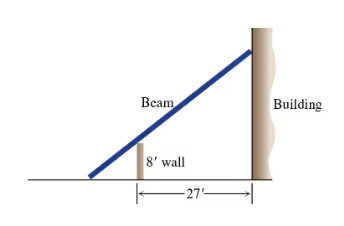
The 8-ft wall shown here stands 27 ft from the building. Find the length of the shortest straight beam that will reach to the side of the building from the ground outside the wall.
Problem 4.7.79
Initial Value Problems
Solve the initial value problems in Exercises 71–90.
dr/dθ = −π sin (πθ), r(0) = 0
Problem 4.5.62
Business and Economics
62. Production level Suppose that c(x)=x^3-20x^2 + 20,000x is the cost of manufacturing x items. Find a production level that will minimize the average cost of making x items.
Problem 4.PE.90
Initial Value Problems
Solve the initial value problems in Exercises 89–92.
dy/dx = (𝓍 + 1/𝓍)² , y(1)= 1
Problem 4.PE.83
Finding Indefinite Integrals
Find the indefinite integrals (most general antiderivatives) in Exercises 73–88. You may need to try a solution and then adjust your guess. Check your answers by differentiation.
∫ sec² s/10 ds
Problem 4.PE.75
Finding Indefinite Integrals
Find the indefinite integrals (most general antiderivatives) in Exercises 73–88. You may need to try a solution and then adjust your guess. Check your answers by differentiation.
__
∫ ( 3√ t + 4/t² ) dt
Problem 4.PE.73
Finding Indefinite Integrals
Find the indefinite integrals (most general antiderivatives) in Exercises 73–88. You may need to try a solution and then adjust your guess. Check your answers by differentiation.
∫ (𝓍³ + 5𝓍 ―7) d𝓍
Problem 4.PE.92
Initial Value Problems
Solve the initial value problems in Exercises 89–92.
d^3 r/dt^3 = - cos t; r''(0) = r'(0) = 0 , r(0) = -1
Problem 4.PE.88
Finding Indefinite Integrals
Find the indefinite integrals (most general antiderivatives) in Exercises 73–88. You may need to try a solution and then adjust your guess. Check your answers by differentiation.
∫ cos³ 𝓍/2 d𝓍
Problem 4.PE.77
Finding Indefinite Integrals
Find the indefinite integrals (most general antiderivatives) in Exercises 73–88. You may need to try a solution and then adjust your guess. Check your answers by differentiation.
∫ 1/( r + 5)²dr