Back
Back
Problem 4.4.53
In Exercises 9–66, graph the function using appropriate methods from the graphing procedures presented just before Example 9, identifying the coordinates of any local extreme points and inflection points. Then find coordinates of absolute extreme points, if any.
53. y = x * √(8 - x²)
Problem 4.4.7
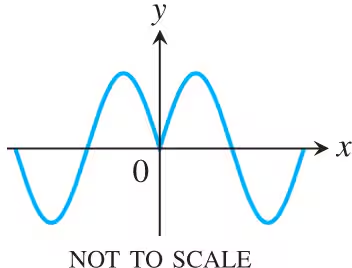
Identify the inflection points and local maxima and minima of the functions graphed in Exercises 1–8. Identify the open intervals on which the functions are differentiable and the graphs are concave up and concave down.
7. y=sin|x|, -2π≤x≤2π
Problem 4.1.45
Finding Critical Points
In Exercises 41–50, determine all critical points and all domain endpoints for each function.
y = x² + 2/x
Problem 4.2.12
Checking the Mean Value Theorem
Which of the functions in Exercises 7–12 satisfy the hypotheses of the Mean Value Theorem on the given interval, and which do not? Give reasons for your answers.
f(x) = {2x − 3, 0 ≤ x ≤ 2
6x − x² − 7, 2 < x ≤ 3
Problem 4.1.43
Finding Critical Points
In Exercises 41–50, determine all critical points and all domain endpoints for each function.
f(x) = x(4 − x)³
Problem 4.5.45
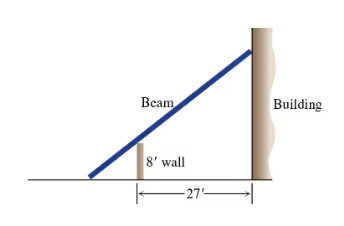
The 8-ft wall shown here stands 27 ft from the building. Find the length of the shortest straight beam that will reach to the side of the building from the ground outside the wall.
Problem 4.8
In Exercises 1–10, find the extreme values (absolute and local) of the function over its natural domain, and where they occur.
__________
y = √ 3 + 2𝓍 ―𝓍²
Problem 4.4.39
In Exercises 9–66, graph the function using appropriate methods from the graphing procedures presented just before Example 9, identifying the coordinates of any local extreme points and inflection points. Then find coordinates of absolute extreme points, if any.
39. y = 8 / (x² + 4) (Witch of Agnesi)
Problem 4.5
In Exercises 1–10, find the extreme values (absolute and local) of the function over its natural domain, and where they occur.
______
y = √𝓍² ― 1
Problem 4.7.79
Initial Value Problems
Solve the initial value problems in Exercises 71–90.
dr/dθ = −π sin (πθ), r(0) = 0
Problem 4.7.85
Initial Value Problems
Solve the initial value problems in Exercises 71–90.
d²r/dt² = 2/t³; dr/dt|ₜ ₌ ₁ =1, r(1) = 1
Problem 4.1.61
Theory and Examples
Maximum height of a vertically moving body The height of a body moving vertically is given by s = −12gt² + υ₀t + s₀, g > 0, with s in meters and t in seconds. Find the body’s maximum height.
Problem 4.3.17
Identifying Extrema
In Exercises 15–18:
a. Find the open intervals on which the function is increasing and those on which it is decreasing.
b. Identify the function’s local and absolute extreme values, if any, saying where they occur.
Problem 4.7.60
Checking Antiderivative Formulas
Verify the formulas in Exercises 57–62 by differentiation.
∫csc²((x − 1)/3)dx = −3cot((x − 1)/3) + C
Problem 4.7.35
Finding Indefinite Integrals
In Exercises 17–56, find the most general antiderivative or indefinite integral. You may need to try a solution and then adjust your guess. Check your answers by differentiation.
∫(−2cost) dt
Problem 4.4.8
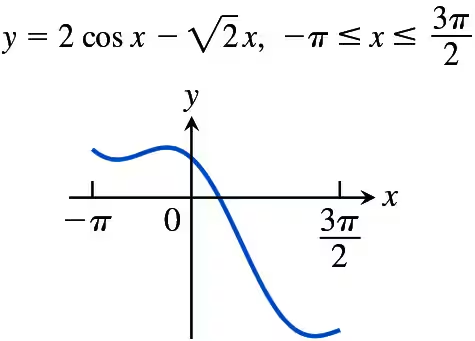
Identify the inflection points and local maxima and minima of the functions graphed in Exercises 1–8. Identify the open intervals on which the functions are differentiable and the graphs are concave up and concave down.
8. y = 2cosx - √2x, -π≤x≤3π/2
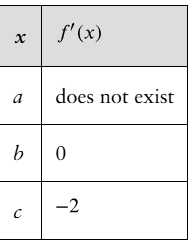
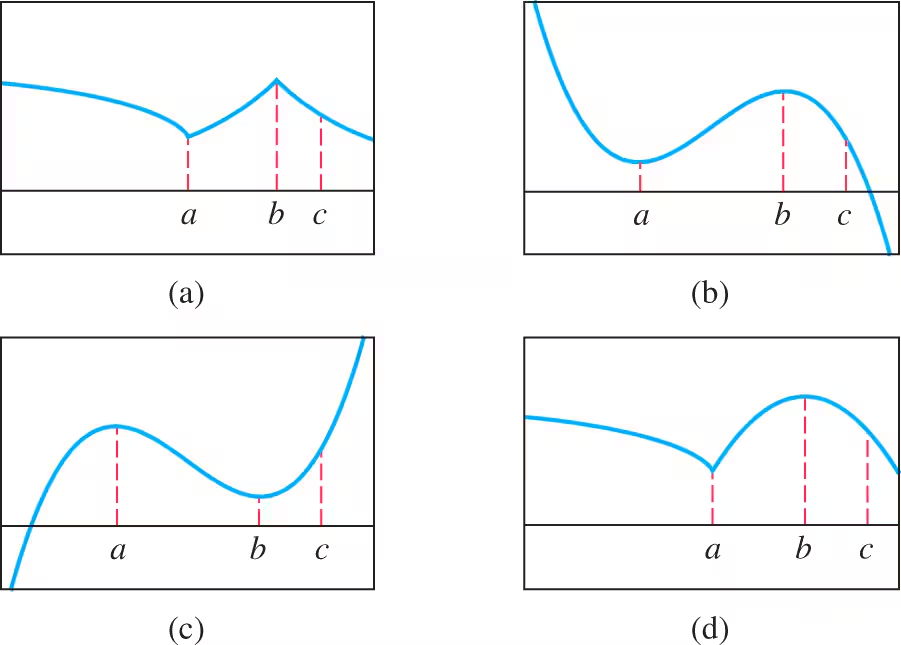
Problem 4.1.13
Finding Extrema from Graphs
In Exercises 11–14, match the table with a graph.
Problem 4.1.7
Finding Extrema from Graphs
In Exercises 7–10, find the absolute extreme values and where they occur.
Problem 4.1.63
Theory and Examples
[Technology Exercise] Graph the functions in Exercises 63–66. Then find the extreme values of the function on the interval and say where they occur.
f(x) = |x − 2| + |x + 3|, −5 ≤ x ≤ 5
Problem 4.7.37
Finding Indefinite Integrals
In Exercises 17–56, find the most general antiderivative or indefinite integral. You may need to try a solution and then adjust your guess. Check your answers by differentiation.
∫7sin(θ/3) dθ
Problem 4.4.85
Each of Exercises 67–88 gives the first derivative of a continuous function y=f(x). Find y'' and then use Steps 2–4 of the graphing procedure described in this section to sketch the general shape of the graph of f.
85. y' = x^(-2/3) (x - 1)
Problem 4.4.82
Each of Exercises 67–88 gives the first derivative of a continuous function y=f(x). Find y'' and then use Steps 2–4 of the graphing procedure described in this section to sketch the general shape of the graph of f.
82. y' = sin t, for 0 ≤ t ≤ 2π
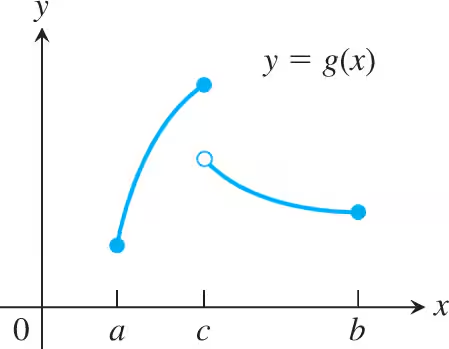
Problem 4.1.5
Finding Extrema from Graphs
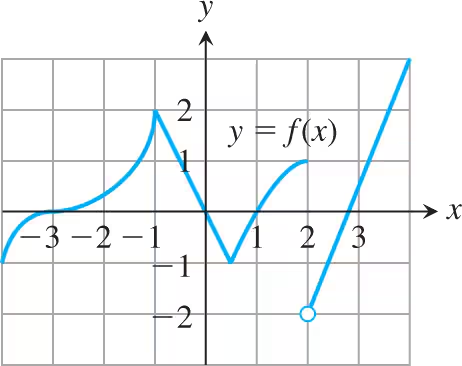
In Exercises 1–6, determine from the graph whether the function has any absolute extreme values on [a, b]. Then explain how your answer is consistent with Theorem 1.
Problem 4.6.2
Root Finding
2. Use Newton's method to estimate the one real solution of x^3 +3x + 1 = 0. Start with x_0 = 0 and then find x_2.
Problem 4.2.9
Checking the Mean Value Theorem
Which of the functions in Exercises 7–12 satisfy the hypotheses of the Mean Value Theorem on the given interval, and which do not? Give reasons for your answers.
f(x) = √(x(1 − x)), [0, 1]
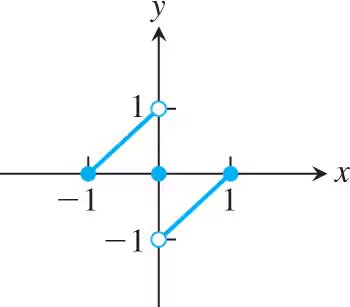
Problem 4.1.15
Finding Extrema from Graphs
In Exercises 15–20, sketch the graph of each function and determine whether the function has any absolute extreme values on its domain. Explain how your answer is consistent with Theorem 1.
f(x) = |x|, −1 < x < 2
Problem 4.7.31
Finding Indefinite Integrals
In Exercises 17–56, find the most general antiderivative or indefinite integral. You may need to try a solution and then adjust your guess. Check your answers by differentiation.
∫2x(1 − x⁻³) dx
Problem 4.2.53
Applications
A marathoner ran the 26.2-mi New York City Marathon in 2.2 hours. Show that at least twice the marathoner was running at exactly 11 mph, assuming the initial and final speeds are zero.
Problem 4.4.27
In Exercises 9–66, graph the function using appropriate methods from the graphing procedures presented just before Example 9, identifying the coordinates of any local extreme points and inflection points. Then find coordinates of absolute extreme points, if any.
y = 1 / (x² - 1)
Problem 4.7.17
Finding Indefinite Integrals
In Exercises 17–56, find the most general antiderivative or indefinite integral. You may need to try a solution and then adjust your guess. Check your answers by differentiation.
∫(x + 1) dx