
Ch. 4 - Applications of Derivatives
Hass - Thomas' Calculus 15th Edition
Hass15th EditionThomas' CalculusISBN: 9780137616077Not the one you use?Change textbook
Chapter 4, Problem 4.1.13

Finding Extrema from Graphs


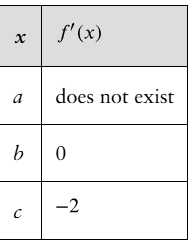
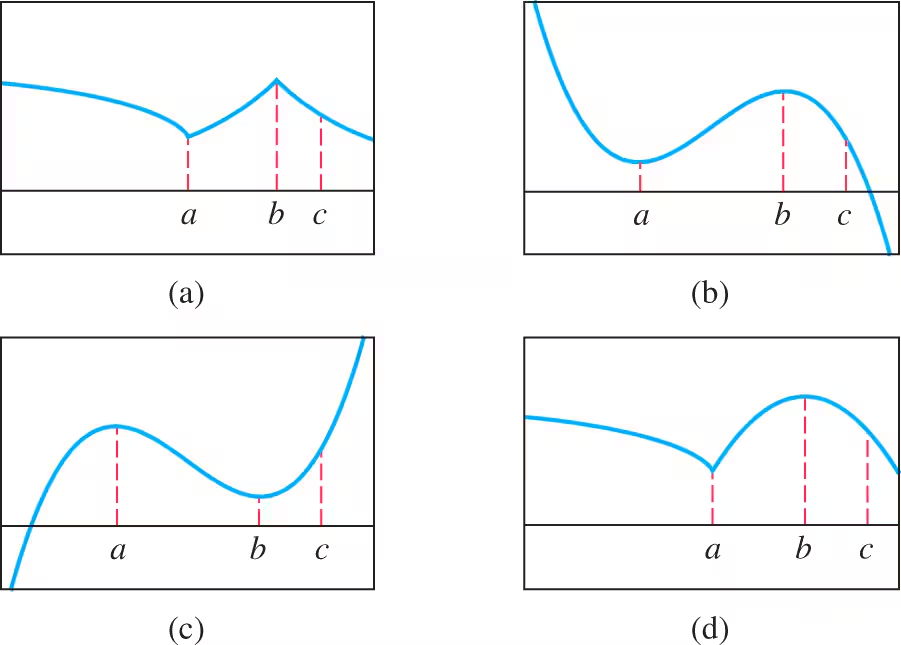
In Exercises 11–14, match the table with a graph.


Verified step by step guidance
1
Step 1: Analyze the table provided. It indicates the behavior of the derivative f'(x) at specific points: at x = a, f'(x) does not exist; at x = b, f'(x) = 0; and at x = c, f'(x) = -2.
Step 2: Understand the implications of the derivative values: - 'f'(x) does not exist' at x = a suggests a sharp corner or cusp in the graph at x = a. - 'f'(x) = 0' at x = b indicates a horizontal tangent line, which is typically a local maximum or minimum. - 'f'(x) = -2' at x = c implies the slope of the tangent line is negative, meaning the graph is decreasing at x = c.
Step 3: Examine the graphs provided (a, b, c, d) and identify the one that matches the behavior described in the table. Look for: - A sharp corner or cusp at x = a. - A horizontal tangent line at x = b. - A decreasing slope at x = c.
Step 4: Compare each graph systematically: - Graph (a): Sharp corner at x = a, horizontal tangent at x = b, decreasing slope at x = c. - Graph (b): Smooth curve at x = a, horizontal tangent at x = b, decreasing slope at x = c. - Graph (c): Smooth curve at x = a, horizontal tangent at x = b, increasing slope at x = c. - Graph (d): Sharp corner at x = a, horizontal tangent at x = b, decreasing slope at x = c.
Step 5: Based on the analysis, select the graph that matches all the conditions described in the table. The correct graph is the one with a sharp corner at x = a, a horizontal tangent at x = b, and a decreasing slope at x = c.

Verified video answer for a similar problem:

This video solution was recommended by our tutors as helpful for the problem above.
Video duration:
4m
Was this helpful?

Key Concepts

Here are the essential concepts you must grasp in order to answer the question correctly.

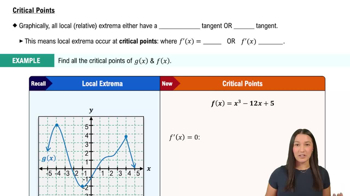
Critical Points

Critical points occur where the derivative of a function is either zero or undefined. These points are essential for finding local extrema, as they indicate where the function's slope changes, potentially leading to local maxima or minima. In the given table, point 'b' is a critical point since the derivative is zero, while point 'a' is critical because the derivative does not exist.
Recommended video:
04:50
Critical Points

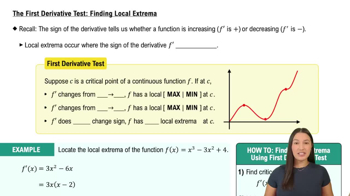
First Derivative Test

The First Derivative Test is a method used to determine whether a critical point is a local maximum, local minimum, or neither. By analyzing the sign of the derivative before and after the critical point, one can infer the behavior of the function. For instance, if the derivative changes from positive to negative at a critical point, it indicates a local maximum.
Recommended video:
07:09
The First Derivative Test: Finding Local Extrema

Existence of Derivatives

The existence of a derivative at a point is crucial for determining the behavior of a function at that point. If the derivative does not exist, as in point 'a', it may indicate a cusp, corner, or vertical tangent, which can affect the function's continuity and extrema. Understanding where derivatives exist or do not exist helps in analyzing the overall shape and critical features of the graph.
Recommended video:
03:07
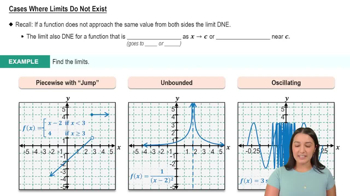
Cases Where Limits Do Not Exist
Related Practice
Textbook Question

Identifying Extrema


In Exercises 19–40:


a. Find the open intervals on which the function is increasing and those on which it is decreasing.


b. Identify the function’s local extreme values, if any, saying where they occur.


f(x) = (x² − 3) / (x − 2), x ≠ 2

Textbook Question

Checking the Mean Value Theorem


Which of the functions in Exercises 7–12 satisfy the hypotheses of the Mean Value Theorem on the given interval, and which do not? Give reasons for your answers.


f(x) = √(x(1 − x)), [0, 1]

Textbook Question

Applications


Stopping a motorcycle The State of Illinois Cycle Rider Safety Program requires motorcycle riders to be able to brake from 30 mph (44 ft/sec) to 0 in 45 ft. What constant deceleration does it take to do that?

Textbook Question

Finding Indefinite Integrals

Find the indefinite integrals (most general antiderivatives) in Exercises 73–88. You may need to try a solution and then adjust your guess. Check your answers by differentiation.

∫ cos³ 𝓍/2 d𝓍

Textbook Question

Finding Indefinite Integrals

Find the indefinite integrals (most general antiderivatives) in Exercises 73–88. You may need to try a solution and then adjust your guess. Check your answers by differentiation.

__

∫ ( 3√ t + 4/t² ) dt

Textbook Question

Finding Indefinite Integrals


In Exercises 17–56, find the most general antiderivative or indefinite integral. You may need to try a solution and then adjust your guess. Check your answers by differentiation.


∫(t√t + √t) / t² dt