
Ch. 4 - Applications of Derivatives
Hass - Thomas' Calculus 15th Edition
Hass15th EditionThomas' CalculusISBN: 9780137616077Not the one you use?Change textbook
Chapter 4, Problem 4.7.104

Applications


Stopping a motorcycle The State of Illinois Cycle Rider Safety Program requires motorcycle riders to be able to brake from 30 mph (44 ft/sec) to 0 in 45 ft. What constant deceleration does it take to do that?

Verified step by step guidance
1
Identify the known values: initial velocity \(v_0 = 44\) ft/sec, final velocity \(v = 0\) ft/sec, and stopping distance \(d = 45\) ft.
Recall the kinematic equation that relates velocity, acceleration, and distance without time: \(v^2 = v_0^2 + 2 a d\), where \(a\) is the acceleration (or deceleration in this case).
Substitute the known values into the equation: \(0 = (44)^2 + 2 \times a \times 45\).
Solve the equation for \(a\) to find the constant deceleration required: rearrange to \(a = -\frac{(44)^2}{2 \times 45}\).
Interpret the negative sign of \(a\) as indicating deceleration (slowing down), which matches the physical situation of braking.

Verified video answer for a similar problem:

This video solution was recommended by our tutors as helpful for the problem above.
Video duration:
5m
Was this helpful?

Key Concepts

Here are the essential concepts you must grasp in order to answer the question correctly.

Kinematic Equations for Constant Acceleration

Kinematic equations describe the motion of objects under constant acceleration. They relate velocity, acceleration, displacement, and time, allowing calculation of unknown variables when others are known. In this problem, the equation v² = v₀² + 2aΔx is useful to find acceleration given initial velocity, final velocity, and displacement.
Recommended video:
08:14
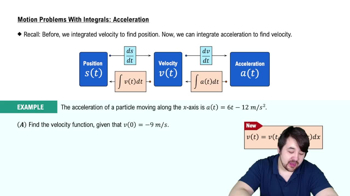
Using The Acceleration Function

Unit Conversion

Unit conversion ensures all quantities are expressed in compatible units before calculations. Here, speed is given in miles per hour and feet per second, so converting 30 mph to feet per second or vice versa is essential to maintain consistency and accuracy in solving the problem.
Recommended video:
5:10
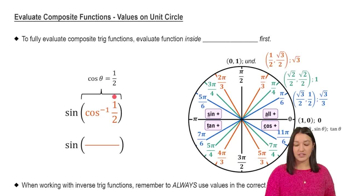
Evaluate Composite Functions - Values on Unit Circle

Deceleration as Negative Acceleration

Deceleration refers to acceleration that reduces the speed of an object, represented as a negative acceleration value. Understanding that braking involves a negative acceleration helps correctly interpret the sign and magnitude of the acceleration calculated from the kinematic equations.
Recommended video:
06:15
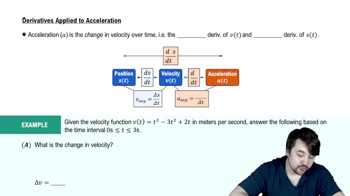
Derivatives Applied To Acceleration