
Initial Value Problems
Solve the initial value problems in Exercises 89–92.
d^3 r/dt^3 = - cos t; r''(0) = r'(0) = 0 , r(0) = -1

 Verified step by step guidance
 05:04
05:04
 6:04
6:04 05:53
05:53Initial Value Problems
Solve the initial value problems in Exercises 89–92.
d^3 r/dt^3 = - cos t; r''(0) = r'(0) = 0 , r(0) = -1
Identifying Extrema
In Exercises 19–40:
a. Find the open intervals on which the function is increasing and those on which it is decreasing.
b. Identify the function’s local extreme values, if any, saying where they occur.
f(x) = (x² − 3) / (x − 2), x ≠ 2
Finding Extrema from Graphs
In Exercises 11–14, match the table with a graph.
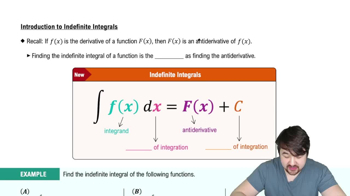
Finding Indefinite Integrals
Find the indefinite integrals (most general antiderivatives) in Exercises 73–88. You may need to try a solution and then adjust your guess. Check your answers by differentiation.
∫ 𝓍³ (1 + 𝓍⁴ )⁻¹/⁴ d𝓍
Finding Indefinite Integrals
Find the indefinite integrals (most general antiderivatives) in Exercises 73–88. You may need to try a solution and then adjust your guess. Check your answers by differentiation.
__
∫ ( 3√ t + 4/t² ) dt
Finding Indefinite Integrals
In Exercises 17–56, find the most general antiderivative or indefinite integral. You may need to try a solution and then adjust your guess. Check your answers by differentiation.
∫(t√t + √t) / t² dt