Ch. 4 - Applications of Derivatives
Hass - Thomas' Calculus 15th Edition
Hass15th EditionThomas' CalculusISBN: 9780137616077Not the one you use?Change textbook
Chapter 4, Problem 4.PE.81

Finding Indefinite Integrals
Find the indefinite integrals (most general antiderivatives) in Exercises 73–88. You may need to try a solution and then adjust your guess. Check your answers by differentiation.

∫ 𝓍³ (1 + 𝓍⁴ )⁻¹/⁴ d𝓍

Verified step by step guidance
1
Identify the integral to solve: \(\int x^{3} (1 + x^{4})^{-\frac{1}{4}} \, dx\).
Look for a substitution that simplifies the integral. Notice that the expression inside the parentheses is \(1 + x^{4}\), and its derivative involves \(x^{3}\). This suggests using the substitution \(u = 1 + x^{4}\).
Compute the differential \(du\) by differentiating \(u\) with respect to \(x\): \(du = 4x^{3} \, dx\). From this, solve for \(x^{3} \, dx\) to express it in terms of \(du\): \(x^{3} \, dx = \frac{du}{4}\).
Rewrite the integral in terms of \(u\) using the substitution: replace \(x^{3} \, dx\) with \(\frac{du}{4}\) and \((1 + x^{4})^{-\frac{1}{4}}\) with \(u^{-\frac{1}{4}}\). The integral becomes \(\int u^{-\frac{1}{4}} \cdot \frac{du}{4}\).
Integrate the new integral with respect to \(u\): \(\frac{1}{4} \int u^{-\frac{1}{4}} \, du\). Use the power rule for integration, which states \(\int u^{n} \, du = \frac{u^{n+1}}{n+1} + C\) for \(n \neq -1\). After integrating, substitute back \(u = 1 + x^{4}\) to express the answer in terms of \(x\).

Verified video answer for a similar problem:

This video solution was recommended by our tutors as helpful for the problem above.
Video duration:
2m
Was this helpful?

Key Concepts

Here are the essential concepts you must grasp in order to answer the question correctly.

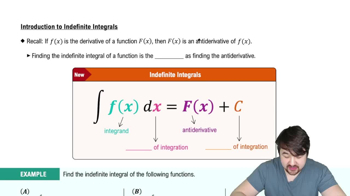
Indefinite Integrals and Antiderivatives

An indefinite integral represents the most general antiderivative of a function, including an arbitrary constant of integration. It reverses differentiation, finding a function whose derivative matches the integrand. Understanding this concept is essential for solving integrals and verifying solutions by differentiation.
Recommended video:
05:04
Introduction to Indefinite Integrals

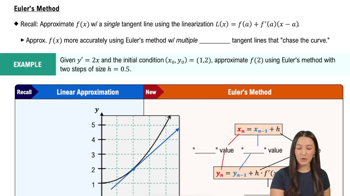
Substitution Method

The substitution method simplifies integration by changing variables to transform a complex integral into a more manageable form. Typically, a part of the integrand is set as a new variable, allowing the integral to be rewritten in terms of this variable. This technique is especially useful when the integrand contains composite functions.
Recommended video:
07:33
Euler's Method

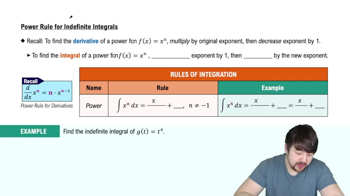
Power Rule for Integration

The power rule states that the integral of x^n (for n β‰  -1) is (x^(n+1))/(n+1) plus a constant. This rule is fundamental for integrating polynomial expressions and powers of variables. Recognizing when to apply this rule after substitution helps in efficiently solving integrals involving powers.
Recommended video:
04:04
Power Rule for Indefinite Integrals