Ch. 4 - Applications of Derivatives
Hass - Thomas' Calculus 15th Edition
Hass15th EditionThomas' CalculusISBN: 9780137616077Not the one you use?Change textbook
Chapter 4, Problem 4.7.102

Applications


Liftoff from Earth A rocket lifts off the surface of Earth with a constant acceleration of 20 m/sec². How fast will the rocket be going 1 min later?

Verified step by step guidance
1
Identify the known quantities: the acceleration \(a = 20 \ \text{m/s}^2\) and the time \(t = 1 \ \text{minute}\). Convert the time to seconds since acceleration is in meters per second squared. So, \(t = 60 \ \text{seconds}\).
Recall the kinematic equation that relates velocity, acceleration, and time when starting from rest: \(v = v_0 + a t\). Since the rocket starts from rest, the initial velocity \(v_0 = 0\).
Substitute the known values into the equation: \(v = 0 + (20)(60)\).
Simplify the expression to find the velocity after 60 seconds, which will give the speed of the rocket 1 minute after liftoff.
Interpret the result as the rocket's speed in meters per second at 1 minute after liftoff.

Verified video answer for a similar problem:

This video solution was recommended by our tutors as helpful for the problem above.
Video duration:
2m
Was this helpful?

Key Concepts

Here are the essential concepts you must grasp in order to answer the question correctly.

Constant Acceleration

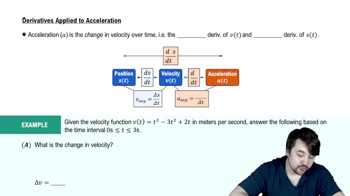
Constant acceleration means the velocity of an object changes at a steady rate over time. In this problem, the rocket's acceleration is 20 m/s², which means its speed increases by 20 meters per second every second.
Recommended video:
06:15
Derivatives Applied To Acceleration

Velocity-Time Relationship

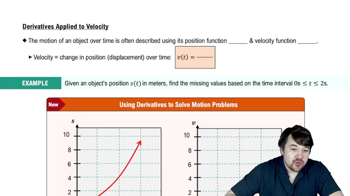
When acceleration is constant, velocity changes linearly with time. The velocity after a certain time can be found using the formula v = at, where 'a' is acceleration and 't' is time elapsed.
Recommended video:
06:29
Derivatives Applied To Velocity

Unit Conversion and Time Calculation

Time must be expressed in consistent units when applying formulas. Since acceleration is in meters per second squared and time is given in minutes, converting 1 minute to 60 seconds is essential for accurate calculation.
Recommended video:
5:10
Evaluate Composite Functions - Values on Unit Circle
Related Practice
Textbook Question

Initial Value Problems

Solve the initial value problems in Exercises 89–92.


dy/dx = (𝓍 + 1/𝓍)² , y(1)= 1

Textbook Question

Finding Indefinite Integrals

Find the indefinite integrals (most general antiderivatives) in Exercises 73–88. You may need to try a solution and then adjust your guess. Check your answers by differentiation.

∫ sec² s/10 ds

Textbook Question

Identifying Extrema


In Exercises 15–18:


a. Find the open intervals on which the function is increasing and those on which it is decreasing.


b. Identify the function’s local and absolute extreme values, if any, saying where they occur.


Textbook Question

Finding Indefinite Integrals

Find the indefinite integrals (most general antiderivatives) in Exercises 73–88. You may need to try a solution and then adjust your guess. Check your answers by differentiation.

∫ cos³ 𝓍/2 d𝓍

Textbook Question

54. Fermat’s principle in optics Light from a source A is reflected by a plane mirror to a receiver at point B, as shown in the accompanying figure. Show that for the light to obey Fermat’s principle, the angle of incidence must equal the angle of reflection, both measured from the line normal to the reflecting surface. (This result can also be derived without calculus. There is a purely geometric argument, which you may prefer.)

1
views
Textbook Question

Finding Indefinite Integrals


In Exercises 17–56, find the most general antiderivative or indefinite integral. You may need to try a solution and then adjust your guess. Check your answers by differentiation.


∫(t√t + √t) / t² dt