Ch. 4 - Applications of Derivatives
Hass - Thomas' Calculus 15th Edition
Hass15th EditionThomas' CalculusISBN: 9780137616077Not the one you use?Change textbook
Chapter 4, Problem 4.3.17

Identifying Extrema


In Exercises 15–18:


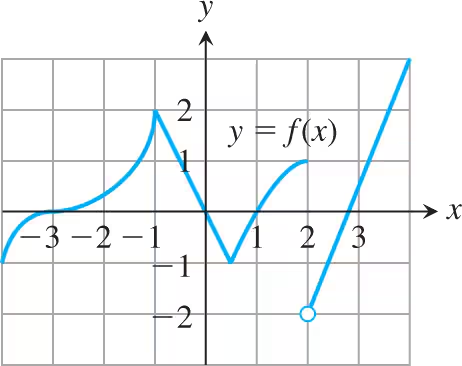
a. Find the open intervals on which the function is increasing and those on which it is decreasing.


b. Identify the function’s local and absolute extreme values, if any, saying where they occur.


Graph of a function showing local maxima and minima, with labeled axes indicating increasing and decreasing intervals.

Verified step by step guidance
1
Observe the graph of the function y = f(x) and identify the critical points where the function changes direction. These points are typically where the derivative is zero or undefined.
Determine the intervals where the function is increasing. A function is increasing on an interval if its derivative is positive over that interval. From the graph, identify the segments where the slope of the function is positive.
Determine the intervals where the function is decreasing. A function is decreasing on an interval if its derivative is negative over that interval. From the graph, identify the segments where the slope of the function is negative.
Identify the local extrema by examining the critical points. A local maximum occurs where the function changes from increasing to decreasing, and a local minimum occurs where the function changes from decreasing to increasing.
Identify the absolute extrema by comparing the values of the function at the critical points and endpoints of the interval. The highest value is the absolute maximum, and the lowest value is the absolute minimum.

Verified video answer for a similar problem:

This video solution was recommended by our tutors as helpful for the problem above.
Video duration:
6m
Was this helpful?

Key Concepts

Here are the essential concepts you must grasp in order to answer the question correctly.

Increasing and Decreasing Intervals

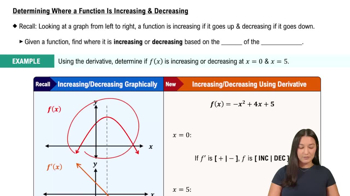
A function is increasing on an interval if, for any two points within the interval, a larger x-value results in a larger y-value. Conversely, it is decreasing if a larger x-value results in a smaller y-value. To determine these intervals, one can analyze the graph's slope or use the first derivative test, where a positive derivative indicates increasing and a negative derivative indicates decreasing.
Recommended video:
07:32
Determining Where a Function is Increasing & Decreasing

Local and Absolute Extrema

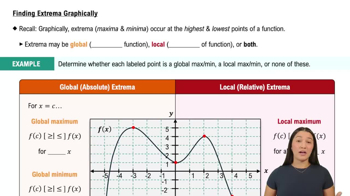
Local extrema are points where a function reaches a local maximum or minimum within a neighborhood, while absolute extrema are the highest or lowest points over the entire domain. Local extrema occur where the derivative changes sign, and absolute extrema can be found by evaluating the function at critical points and endpoints. The graph helps visualize these points as peaks (maxima) or troughs (minima).
Recommended video:
05:58
Finding Extrema Graphically

Critical Points

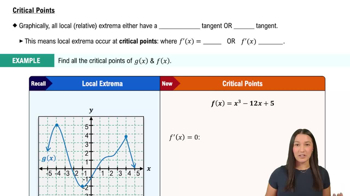
Critical points of a function occur where its derivative is zero or undefined, indicating potential local maxima, minima, or points of inflection. These points are crucial for identifying intervals of increase or decrease and locating extrema. By analyzing the graph or calculating the derivative, one can pinpoint these critical points and assess their nature using the first or second derivative tests.
Recommended video:
04:50
Critical Points
Related Practice
Textbook Question

Finding Extreme Values

In Exercises 1–10, find the extreme values (absolute and local) of the function over its natural domain, and where they occur.


y = 𝓍³ ― 2𝓍 + 4

Textbook Question

Applications


Liftoff from Earth A rocket lifts off the surface of Earth with a constant acceleration of 20 m/sec². How fast will the rocket be going 1 min later?

Textbook Question

Identifying Extrema


In Exercises 19–40:


a. Find the open intervals on which the function is increasing and those on which it is decreasing.


b. Identify the function’s local extreme values, if any, saying where they occur.


f(x) = (x² − 3) / (x − 2), x ≠ 2

Textbook Question

Checking the Mean Value Theorem


Which of the functions in Exercises 7–12 satisfy the hypotheses of the Mean Value Theorem on the given interval, and which do not? Give reasons for your answers.


f(x) = √(x(1 − x)), [0, 1]

Textbook Question

54. Fermat’s principle in optics Light from a source A is reflected by a plane mirror to a receiver at point B, as shown in the accompanying figure. Show that for the light to obey Fermat’s principle, the angle of incidence must equal the angle of reflection, both measured from the line normal to the reflecting surface. (This result can also be derived without calculus. There is a purely geometric argument, which you may prefer.)

1
views
Textbook Question

Finding Indefinite Integrals


In Exercises 17–56, find the most general antiderivative or indefinite integral. You may need to try a solution and then adjust your guess. Check your answers by differentiation.


∫(t√t + √t) / t² dt