Ch. 4 - Applications of Derivatives
Hass - Thomas' Calculus 15th Edition
Hass15th EditionThomas' CalculusISBN: 9780137616077Not the one you use?Change textbook
Chapter 4, Problem 4.4.39

In Exercises 9–66, graph the function using appropriate methods from the graphing procedures presented just before Example 9, identifying the coordinates of any local extreme points and inflection points. Then find coordinates of absolute extreme points, if any.
39. y = 8 / (x² + 4) (Witch of Agnesi)

Verified step by step guidance
1
Step 1: Analyze the function y = 8 / (x² + 4). Start by identifying its domain. Since the denominator x² + 4 is always positive and never zero, the function is defined for all real numbers x (domain: (-∞, ∞)).
Step 2: Find the first derivative y' to locate critical points and determine local extreme points. Use the quotient rule: if y = f(x)/g(x), then y' = (f'(x)g(x) - f(x)g'(x)) / [g(x)]². Here, f(x) = 8 and g(x) = x² + 4.
Step 3: Solve y' = 0 to find critical points. Set the numerator of the derivative equal to zero and solve for x. These x-values are potential locations for local maxima or minima. Verify these points by checking the sign of y' on intervals around each critical point.
Step 4: Find the second derivative y'' to determine concavity and locate inflection points. Use the quotient rule again to differentiate y'. Solve y'' = 0 to find potential inflection points, and verify by checking the sign of y'' on intervals around these points.
Step 5: Evaluate the function y at the critical points, inflection points, and endpoints (if applicable) to determine the coordinates of any absolute extreme points. Use this information to sketch the graph, noting the behavior of the function as x approaches ±∞ and the symmetry of the function (it is even, as y(x) = y(-x)).

Verified video answer for a similar problem:

This video solution was recommended by our tutors as helpful for the problem above.
Video duration:
14m
Was this helpful?

Key Concepts

Here are the essential concepts you must grasp in order to answer the question correctly.

Graphing Rational Functions

Graphing rational functions involves understanding their behavior based on the numerator and denominator. Key steps include identifying asymptotes, intercepts, and the overall shape of the graph. For the function y = 8 / (x² + 4), recognizing that the denominator never equals zero helps in determining the function's continuity and limits.
Recommended video:
5:53
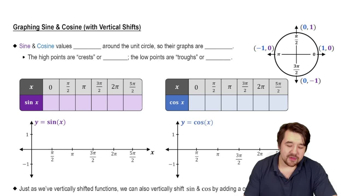
Graph of Sine and Cosine Function

Local and Absolute Extrema

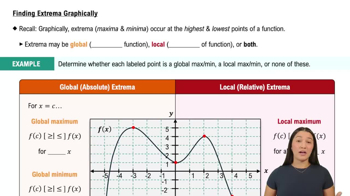
Local extrema refer to points where a function reaches a maximum or minimum value within a specific interval, while absolute extrema are the highest or lowest points over the entire domain. To find these points, one typically uses the first derivative test to identify critical points and the second derivative test to determine their nature.
Recommended video:
05:58
Finding Extrema Graphically

Inflection Points

Inflection points occur where the concavity of a function changes, which can be identified by analyzing the second derivative. For the function y = 8 / (x² + 4), finding inflection points involves setting the second derivative equal to zero and solving for x, indicating where the graph transitions from concave up to concave down or vice versa.
Recommended video:
04:50
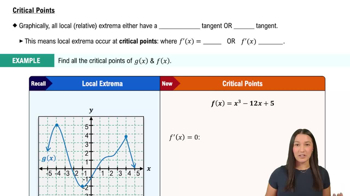
Critical Points