
Ch. 4 - Applications of Derivatives
Hass - Thomas' Calculus 15th Edition
Hass15th EditionThomas' CalculusISBN: 9780137616077Not the one you use?Change textbook
Chapter 4, Problem 4.5.30

30. Find a positive number for which the sum of its reciprocal and four times its square is the smallest possible.

Verified step by step guidance
1
Define the positive number as \( x \). We need to minimize the function \( f(x) = \frac{1}{x} + 4x^2 \).
To find the minimum, first compute the derivative of \( f(x) \). The derivative is \( f'(x) = -\frac{1}{x^2} + 8x \).
Set the derivative \( f'(x) \) equal to zero to find critical points: \( -\frac{1}{x^2} + 8x = 0 \).
Solve the equation \( -\frac{1}{x^2} + 8x = 0 \) for \( x \). This involves finding a common denominator and solving the resulting equation.
Verify that the critical point found is a minimum by using the second derivative test. Compute \( f''(x) \) and check its sign at the critical point.

Verified video answer for a similar problem:

This video solution was recommended by our tutors as helpful for the problem above.
Video duration:
3m
Was this helpful?

Key Concepts

Here are the essential concepts you must grasp in order to answer the question correctly.

Optimization

Optimization involves finding the maximum or minimum value of a function within a given set of constraints. In this problem, we aim to find the positive number that minimizes the expression involving its reciprocal and four times its square. This requires setting up a function to represent the scenario and using calculus techniques to find its minimum value.
Recommended video:
10:13
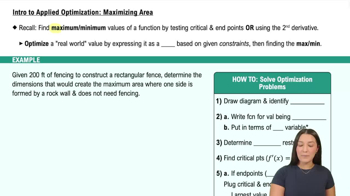
Intro to Applied Optimization: Maximizing Area

Derivatives

Derivatives are a fundamental tool in calculus used to determine the rate of change of a function. To find the minimum value of the function in this problem, we need to compute its derivative and find the critical points where the derivative is zero or undefined. These points are potential candidates for the minimum value of the function.
Recommended video:
05:44
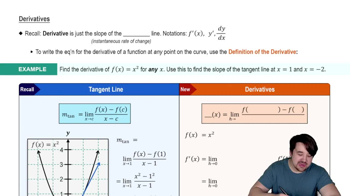
Derivatives

Critical Points and Second Derivative Test

Critical points occur where the derivative of a function is zero or undefined, indicating potential maxima, minima, or inflection points. The second derivative test helps determine the nature of these critical points. If the second derivative is positive at a critical point, the function has a local minimum there, which is essential for solving this optimization problem.
Recommended video:
06:02
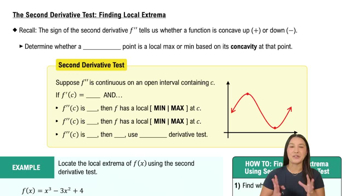
The Second Derivative Test: Finding Local Extrema