
Ch. 4 - Applications of Derivatives
Hass - Thomas' Calculus 15th Edition
Hass15th EditionThomas' CalculusISBN: 9780137616077Not the one you use?Change textbook
Chapter 4, Problem 4.10

In Exercises 1–10, find the extreme values (absolute and local) of the function over its natural domain, and where they occur.


y = (𝓍 + 1) / (𝓍² + 2𝓍 + 2)

Verified step by step guidance
1
First, identify the natural domain of the function y = (𝓍 + 1) / (𝓍² + 2𝓍 + 2). The denominator must not be zero, so solve 𝓍² + 2𝓍 + 2 = 0 to find any restrictions on 𝓍.
Next, find the derivative of the function y with respect to 𝓍 to determine critical points. Use the quotient rule: if y = u/v, then y' = (u'v - uv') / vΒ², where u = 𝓍 + 1 and v = 𝓍² + 2𝓍 + 2.
Set the derivative equal to zero to find critical points. Solve the equation (u'v - uv') = 0 for 𝓍, which will give you the values of 𝓍 where the slope of the tangent is zero, indicating potential extreme values.
Evaluate the second derivative to determine the concavity at the critical points. If the second derivative is positive at a critical point, the function has a local minimum there; if negative, a local maximum.
Finally, analyze the behavior of the function as 𝓍 approaches the boundaries of the domain or infinity to determine if there are any absolute extreme values. Consider the limits of y as 𝓍 approaches any boundary values or infinity.

Verified video answer for a similar problem:

This video solution was recommended by our tutors as helpful for the problem above.
Video duration:
14m
Was this helpful?

Key Concepts

Here are the essential concepts you must grasp in order to answer the question correctly.

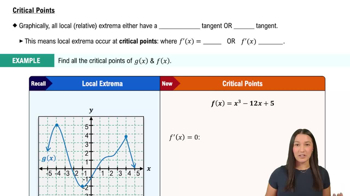
Critical Points

Critical points of a function occur where its derivative is zero or undefined. These points are potential candidates for local extrema. To find them, differentiate the function with respect to x, set the derivative equal to zero, and solve for x. Additionally, check where the derivative does not exist, as these points may also indicate critical points.
Recommended video:
04:50
Critical Points

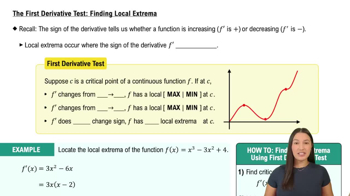
First Derivative Test

The First Derivative Test helps determine whether a critical point is a local maximum, minimum, or neither. By analyzing the sign of the derivative before and after the critical point, one can infer the behavior of the function. If the derivative changes from positive to negative, the point is a local maximum; if it changes from negative to positive, it's a local minimum.
Recommended video:
07:09
The First Derivative Test: Finding Local Extrema

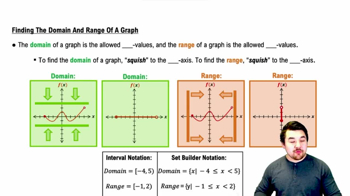
Domain of a Function

The domain of a function is the set of all possible input values (x-values) for which the function is defined. For rational functions, like the one given, the domain excludes values that make the denominator zero. Understanding the domain is crucial for identifying where to look for extrema, as it defines the interval over which the function is analyzed.
Recommended video:
5:10
Finding the Domain and Range of a Graph